The scene is a movie classic: a high-tech military drone silently glides through the dead of night, its operator seeing every detail on the ground below as if it were broad daylight. This raises a common and fascinating question: can military drones see at night?
The short answer is an emphatic yes. But the technology they use is far more advanced than just simple “night vision.”
Most high-performance surveillance drones at night—whether used by the military, police, or search and rescue teams—rely on thermal imaging. While users often search for a “drone with night vision,” understanding the powerful capabilities of thermal is the key to seeing in the dark. This guide will break down the differences, how the technology works, and what the rules are for flying at night.
Looking to Buy a Thermal Drone?
Understanding the technology is the first step. If you are ready to purchase a drone for hunting, inspections, or search and rescue, you need to compare specific models and specs.
Check out our definitive buyer’s guide: The 4 Best Thermal Drones of 2025
What’s the Real Difference Between Thermal and Night Vision for Drones?
💰Save More with Our Discounts & Coupons!
Though often used interchangeably, thermal and night vision are two completely different technologies. In short, thermal imaging sees heat, while night vision sees light. This is the most crucial distinction to understand.
A drone with night vision uses a technology called image intensification, which takes tiny amounts of existing ambient light (from the moon or stars) and magnifies it thousands of times to create a visible image. In contrast, a drone with a thermal camera needs no light at all. It uses a special sensor to detect the invisible infrared (IR) energy, or heat, that all objects emit.
Thermal vs. Night Vision: Head-to-Head Comparison
| Feature | Thermal Imaging Drones | Traditional Night Vision Drones |
|---|---|---|
| How it Works | Detects temperature differences (heat signatures). | Amplifies existing ambient light. |
| Best Conditions | Total darkness, challenging weather. | Low light (e.g., starlight, moonlight). |
| Sees Through Obscurants? | Yes. Can see through smoke, dust, fog, and light camouflage. | No. Is blocked by smoke, fog, and dust. |
| Core Function | Detection. Excellent for finding people, animals, or vehicles. | Identification. Better for recognizing faces or specific objects. |
| Primary Users | Military, police, search and rescue, inspectors. | Less common on drones; more for ground use. |
How Do Thermal Drones See at Night?
Every object, living or not, gives off infrared (IR) energy. A thermal camera on a drone, often made by industry leaders like FLIR, acts like a super-powered thermometer that can see hundreds of feet away.
The sensor, called a microbolometer, absorbs this infrared energy and translates the different heat levels into an image called a thermogram. Hotter objects, like a person or a running engine, will appear as bright white, yellow, or red, while cooler objects like trees and rocks will be dark blue or black. This allows an operator to instantly spot a person hiding in the woods or a vehicle concealed under a tarp in complete darkness.
Understanding Camera Types
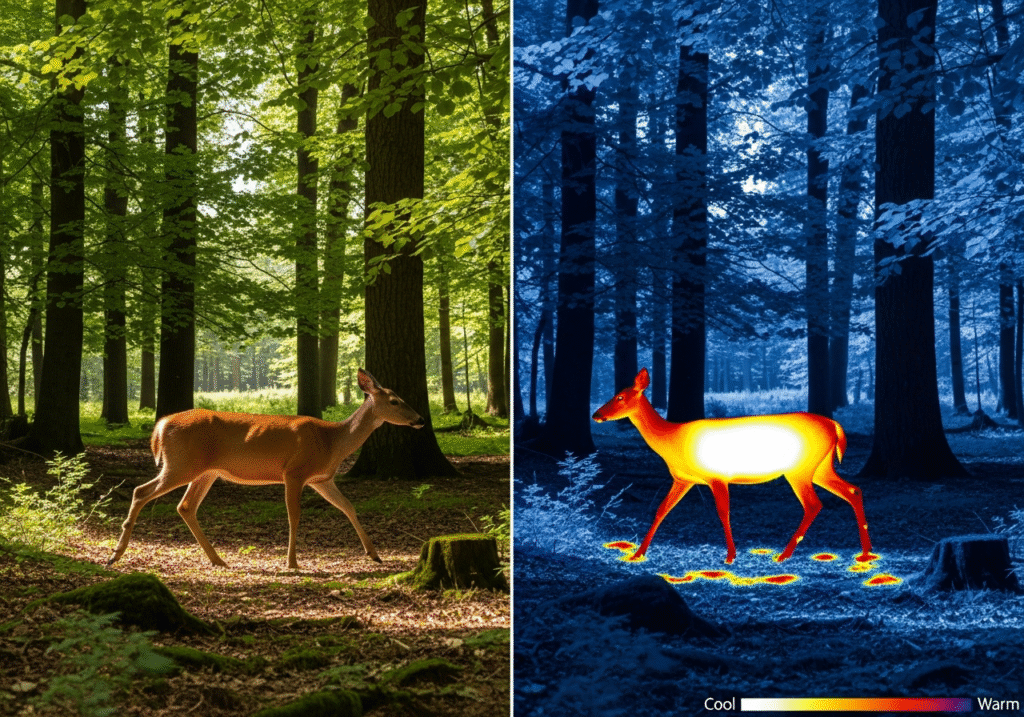
Not all thermal cameras are created equal. To make the right purchase, you need to understand the technology under the hood.
RGB vs. Thermal Cameras
- RGB Cameras: Capture standard visible light (what your eyes see). Essential for visual confirmation and orientation.
- Thermal Imaging Cameras: Capture heat energy. Essential for analysis and detection.
- Hybrid Systems: The best drones, like the Autel EVO Max 4T, combine both sensors. This allows you to overlay thermal data onto a visual image, providing context that makes the thermal blob easier to understand.
Cooled vs. Uncooled Thermal Cameras
- Uncooled Thermal Cameras: The most common type in drones. They are compact, energy-efficient, and affordable. They offer sufficient performance for almost all SAR, inspection, and public safety uses.
- Cooled Thermal Cameras: These use an internal cryogenic cooler to supercharge the sensor’s sensitivity. They are incredibly expensive, heavy, and typically reserved for specialized military or scientific applications requiring extreme precision.
So, Do Any Drones Use True Night Vision?
💰Save More with Our Discounts & Coupons!
While far less common for drone applications, true night vision (image intensification) does exist. However, it has significant drawbacks for aerial use compared to thermal imaging:
- Needs Some Light: It’s ineffective in total darkness with zero ambient light.
- Can Be Blinded: Bright lights from a flashlight, car, or explosion can overwhelm the sensor, causing it to “white out” and become temporarily useless.
- Limited by Weather: It cannot see through fog, smoke, or heavy rain.
Because thermal imaging overcomes all these limitations, it has become the gold standard for any serious drone with night vision capabilities.
Who Uses Drones with Thermal Imaging? (Real-World Applications)
The ability to see heat signatures from the air is a game-changer for several professions.
Military and Surveillance Operations
To answer the original question: yes, military drones are masters of the night. Advanced UAVs like the MQ-9 Reaper use powerful thermal imaging and infrared sensors for surveillance, reconnaissance, and targeting. This allows them to track enemy movements, identify vehicles, and monitor situations without being detected.
Law Enforcement and Police
Police departments widely use drones with thermal imaging. A police drone can track a fleeing suspect in the dark, locate a weapon that was thrown into bushes, or monitor a large crowd. They are invaluable for improving officer safety and situational awareness.
Search and Rescue (SAR)
This is one of the most powerful uses for thermal drones. A SAR team can scan a huge, forested area at night and quickly spot the heat signature of a lost hiker or missing person, a task that would take ground teams hours or days.
Firefighting
Thermal drones provide situational awareness that was previously impossible. Fire commanders can fly a drone over a burning structure to:
- See through smoke to locate the seat of the fire.
- Identify hotspots on roofs to prevent structural collapse and injury to firefighters.
- Monitor containment lines during wildfires to ensure no embers have crossed over.
Industrial & Utility Inspections
Inspecting vast infrastructure is dangerous and costly. Thermal drones make it safer and faster.
- Solar Farms: A malfunctioning solar panel gets hotter than working ones. A thermal drone can map an entire farm in minutes, instantly pinpointing defective cells.
- Power Lines: Overheating components on transmission towers signal potential failure. Drones can detect these thermal anomalies from a safe distance, preventing outages.
Agricultural Monitoring
Precision agriculture relies on data. Thermal imagery helps farmers assess crop health by detecting water stress (transpiration cools plants; stressed plants are hotter) and identifying irrigation leaks before they destroy a harvest.
Can a Civilian Fly a Drone at Night?
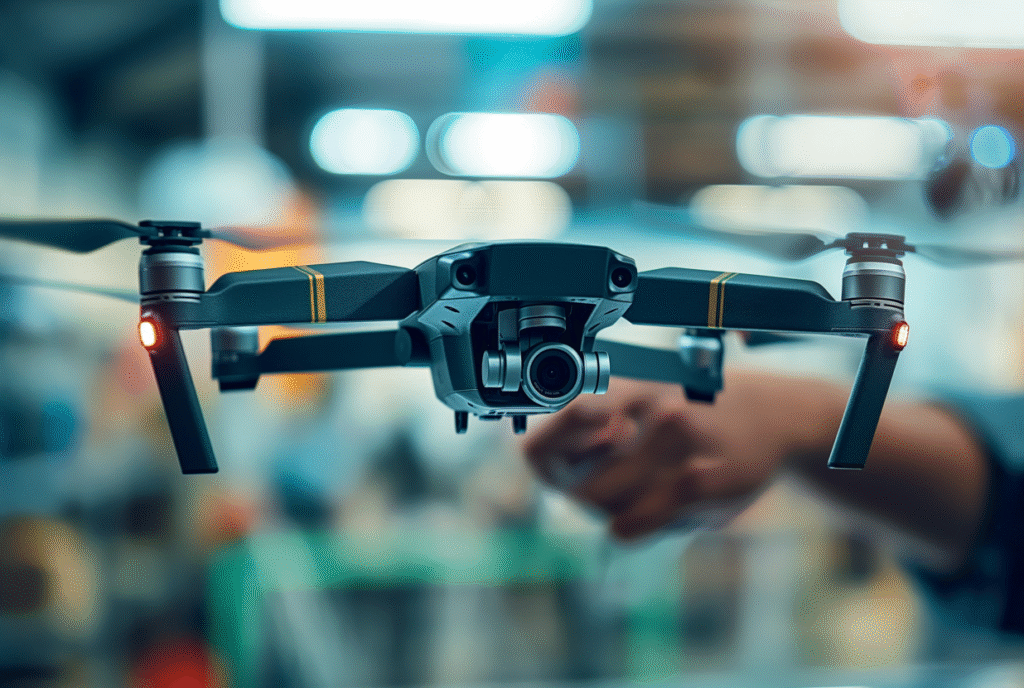
Yes, civilians can legally fly drones at night, but you must follow specific FAA rules. If you are flying for fun or commercially under Part 107, you must equip your drone with anti-collision lights that are visible for at least three statute miles. Recreational flyers must also have passed the FAA’s TRUST test. This ensures that other aircraft can see and avoid your drone in the dark.
Answering Your Other Questions About Night-Flying Drones
Most civilian drones are identified by their flashing anti-collision lights (usually white, red, or green). Military surveillance drones at night often fly at very high altitudes and may not show any visible lights, making them virtually impossible to spot from the ground.
A thermal camera on a drone can detect areas of heat loss from your house, like poorly insulated windows or walls. However, it cannot see through solid objects like walls or curtains. It only sees the temperature of the surface it is looking at.
It depends on the mission and airspace. When operating in shared airspace or during takeoff/landing, military drones follow regulations that require lights. During covert surveillance missions, these lights would likely be turned off.
Conclusion: Thermal Imaging is the Real “Night Vision”
The next time you wonder about a drone with night vision, you’ll know the real story. For nearly every serious application—from military surveillance to saving lives—the answer is thermal imaging. By detecting invisible heat, these incredible machines have conquered the darkness, providing an unparalleled view of the world when the lights go out.