Thermal imaging has transformed from a military secret to an essential tool for commercial industries. Whether you are tracking deer, inspecting solar panels, or conducting search and rescue operations, you know that standard cameras aren’t enough. You need to see heat.
But thermal drones are a major investment, ranging from $3,000 to over $15,000. Making the wrong choice can be costly.
This guide cuts through the noise to review the best thermal drones on the market in 2025. We analyze the top models from DJI, Autel, and FLIR to help you find the specific tool that matches your budget and mission.
Note: Not sure how thermal imaging differs from standard night vision? Read our deep-dive comparison here to understand the science before you buy.
💰Save More with Our Discounts & Coupons!

What Are Thermal Drones? (The Overview)
A thermal drone is more than just a flying camera; it is a highly sophisticated data collection tool. Unlike a standard RGB camera that captures visible light, a thermal camera detects infrared radiation—essentially heat energy—emitted by objects.
This capability allows operators to visualize temperature differences in the environment. These cameras operate in the long-wave infrared spectrum (8 to 14 micrometers), enabling them to “see” clearly in complete darkness, through thick smoke, and amidst light fog or dust.
Key Features
- Heat Signature Detection: The core function. Infrared sensors and microbolometers capture radiation and translate it into a visible image (a thermogram), where hotter objects typically appear brighter or a different color than cooler backgrounds.
- Modular Design: Many high-end enterprise drones, like the DJI Matrice 30T, feature interchangeable payloads. This adaptability allows operators to swap between visual, multispectral, and thermal sensors depending on the mission.
The Costs of Thermal Drones (2025)
Let’s be realistic: thermal technology is an investment.
| Grade | Price Range | Who It’s For | Example Features |
|---|---|---|---|
| Entry-Level | $500 – $5,000 | Hobbyists, Basic Inspections | Basic thermal resolution, shorter battery life. |
| Mid-Range | $5,000 – $15,000 | Professional SAR, Agriculture | Higher resolution (640×512), hybrid sensors, robust flight time. |
| Enterprise | $15,000+ | Heavy Industry, Government | Advanced radiometry, interchangeable payloads, RTK precision. |
Don’t forget Operational Costs: Beyond the sticker price, budget for Pilot Certification (FAA Part 107), insurance, spare batteries ($200-$500 each), and maintenance.
Quick Picks: The Top Thermal Drones at a Glance
| Drone Model | Best For | Approx. Price | Thermal Resolution |
|---|---|---|---|
| DJI Mavic 3 Thermal | Overall Value & Hunting | ~$5,500 | 640 x 512 |
| DJI Matrice 30T | Public Safety & Weather | ~$10,000+ | 640 x 512 |
| Autel EVO Max 4T | Autonomous Missions | ~$9,000 | 640 x 512 |
| Teledyne FLIR SIRAS | Data Security (NDAA) | ~$9,000+ | 640 x 512 (Radiometric) |
In-Depth Reviews: Which Thermal Drone Should You Buy?
Ready to buy? The landscape has evolved. Here are the top picks dominating the market this year for their performance, reliability, and features.
The Versatile Workhorse – DJI Mavic 3 Thermal (M3T)
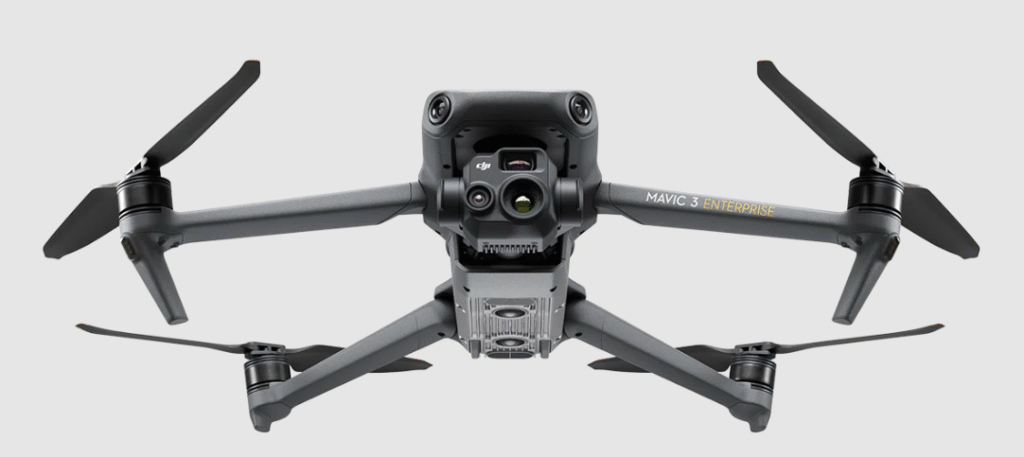
For 90% of users—including hunters, roof inspectors, and private security—the Mavic 3T is the perfect balance of power and portability.
Best Application: Deer Recovery & Home Inspections. It offers the best “bang for your buck” for finding heat signatures quickly without bulky enterprise gear.
The Pros: It fits in a small bag, deploys in under minute, and features a high-resolution 640×512 thermal sensor. It also includes a mechanical shutter on its visual camera, which is crucial for high-speed mapping.
The Cons: It is not waterproof. You cannot fly this in heavy rain.
The rescue champion: DJI Matrice 30T
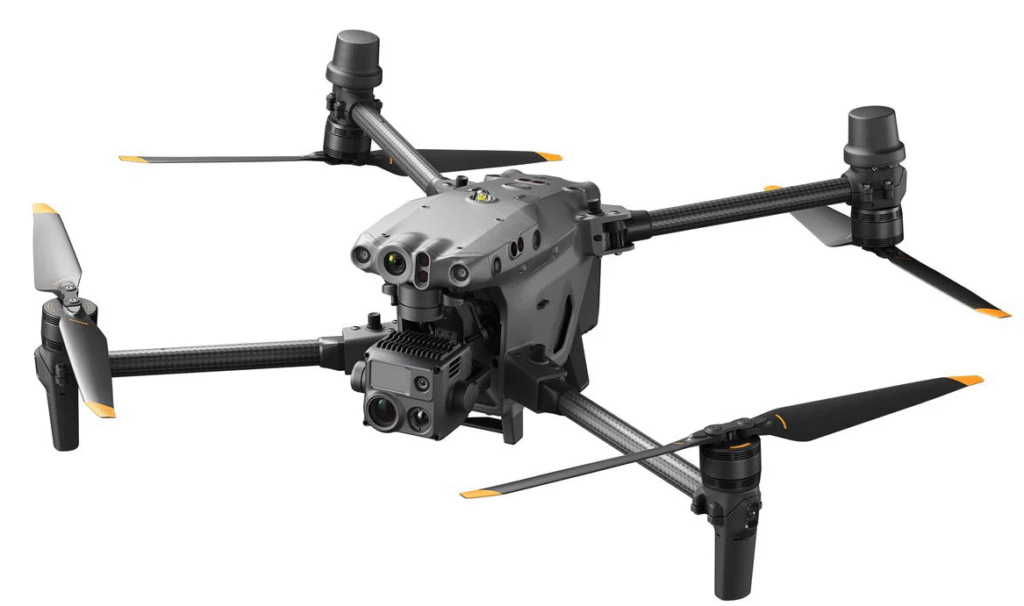
The DJI Matrice 30T is widely considered the gold standard for enterprise versatility. It combines portability with extreme power.
- The Pros: It has an IP55 rating, meaning it can fly in heavy rain, snow, and dust. It features a built-in laser rangefinder that pinpoints the GPS coordinates of any heat signature you see—a lifesaver for Search and Rescue (SAR) teams.
- The Cons: Heavier and larger than the Mavic series; requires more setup time.
- Best Application: Police & Fire Departments. The durability ensures it works when first responders need it most.
💰Save More with Our Discounts & Coupons!
Best Non-Chinese Option: Teledyne FLIR SIRAS
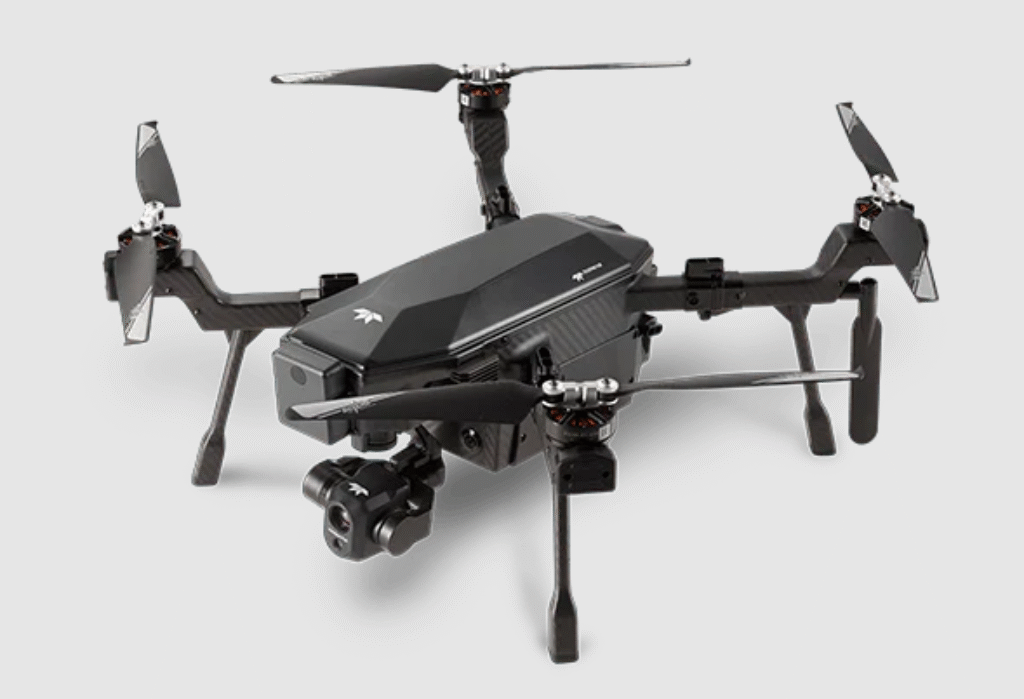
With growing concerns over data privacy and bans on Chinese-made drones (like DJI/Autel) in certain US government sectors, the FLIR SIRAS is the top alternative.
- The Pros: It utilizes Teledyne FLIR’s legendary thermal sensor tech (the industry standard). Crucially, it is not geofenced, meaning it won’t stop you from taking off in restricted zones if you have authorization (a common frustration with DJI). It prioritizes data security with no cloud connection requirements.
- The Cons: Lacks some of the automated flight modes found in DJI competitors.
- Best Application: Government & Critical Infrastructure. Essential for contracts that require NDAA compliance or strict data isolation.
Best Versatile Competitor: Autel EVO Max 4T

Autel is DJI’s fiercest competitor, and the EVO Max 4T is a powerhouse. It stands out for its autonomous flight capabilities.
- The Pros: Unlike most drones that rely solely on GPS, the Max 4T uses millimeter-wave radar and visual sensors to fly inside buildings or under bridges (where GPS fails) without crashing. It also boasts “A-Mesh” networking, allowing multiple drones to communicate.
- The Cons: The ecosystem of accessories is smaller than DJI’s.
- Best Application: Complex Industrial Inspections. Ideal for flying in GPS-denied environments like mines or dense bridge underpasses.
Key Buyer Considerations
When shopping for a thermal drone, ignore the marketing fluff and check these three specifications.
1. Thermal Resolution (Don’t Go Below 640×512)
In 2025, 640×512 is the standard for professional work.
- Low Res (160×120): You will see “blobs.” You can tell something is there, but you won’t know if it’s a person, a deer, or a hot rock until you get very close.
- High Res (640×512): You can identify limbs on a person or legs on a deer from 400 feet up. Do not compromise on this if you are doing recovery or rescue work.
2. Radiometric vs. Non-Radiometric
- Radiometric: The drone measures the exact temperature of specific pixels. This is mandatory for industrial inspections (e.g., “Is that power line insulator 150°F or 300°F?”).
- Non-Radiometric: It only shows relative heat (hotter vs. colder). This is fine for spotting deer or people, but useless for inspecting machinery.
3. Lens Focal Length
Different missions need different fields of view (FOV).
- Wide Angle (Examples: 9mm – 13mm): Best for SAR and spotting. You want to scan a huge field quickly.
- Telephoto/Zoom: Best for power line inspections where you must keep a safe distance from high-voltage wires while spotting tiny overheating components.
4. Flight Time
Look for a real-world flight time of at least 30-40 minutes. Thermal missions often involve scanning large areas, and landing to swap batteries costs precious time.
💰Save More with Our Discounts & Coupons!
Frequently Asked Questions (FAQ)
The DJI Mavic 3 Thermal (M3T) is widely considered excellent for deer recovery. It is compact, relatively affordable for the technology, and features a high-resolution 640×512 thermal sensor that can easily spot heat signatures in brush.
If your work involves finding things (people, animals, defects) that are hidden, absolutely. For a roofing company, finding a leak in minutes rather than hours pays for the drone quickly. For a search team, the value of finding a lost child is incalculable.
Yes. If you are using the drone for any purpose other than pure recreational fun (like search and rescue, inspections, or even recovering deer for a fee), you must have an FAA Part 107 Commercial Drone License in the United States.
It depends on the lens and target size. A human can be detected at nearly a mile away with a high-end sensor, but identification (knowing who it is) requires being much closer. For precise temperature readings, you typically need to be within 50-100 feet.
Expect to pay between $5,000 and $8,000 for a high-quality professional thermal drone like the Mavic 3T or Autel EVO II Dual 640T. Enterprise units like the Matrice 30T start around $10,000 and go up from there.
Conclusion
Thermal drones represent one of the most transformative technologies available today. By rendering the invisible visible, they empower professionals to work safer, faster, and smarter. Whether you choose a powerhouse like the Matrice 30T or a versatile tool like the Autel EVO Max, investing in thermal capabilities unlocks a new dimension of aerial data.
Ready to elevate your operations? Explore our curated deals on the best thermal drones available right now on Dealibrium!