You see “box wall” and “stitch-through” on jacket spec sheets and assume they’re just technical jargon. They’re not. The difference between these two construction methods determines whether you’ll have cold spots at seams or even warmth across your jacket—and it accounts for up to 15% of your total insulation.
This guide decodes the three main baffle types using lab research on down jacket construction, shows you exactly where you lose warmth, and tells you when lightweight stitching is actually the smarter choice.
💰Save More with Our Discounts & Coupons!


What baffles actually do (and why they matter)
Down doesn’t insulate itself—the air trapped inside does. But down is so fluffy that it migrates: gravity pulls it down, movement shuffles it around, and sitting compresses it. Baffles are compartments sewn or bonded between fabric layers that contain the down and prevent it from shifting.
Think of baffles as tiny sleeping bags inside your jacket, each holding a precise amount of down exactly where it’s supposed to be. Remove the baffles and your down jacket becomes a lump of insulation at your knees after two hours of wear.
The three main construction types are:
- Box wall (warmest, bulkiest)
- Stitch-through (lightest, coldest)
- Welded/bonded (rare, most technical)
Each trades warmth for weight, and choosing the right one depends on your actual use case.
Pro Tip: Baffle design affects real-world insulation more than fill power alone. A poorly baffled 800-fill jacket will feel colder than a well-baffled 600-fill jacket in extended wear.
Box wall: Maximizing warmth by holding the line
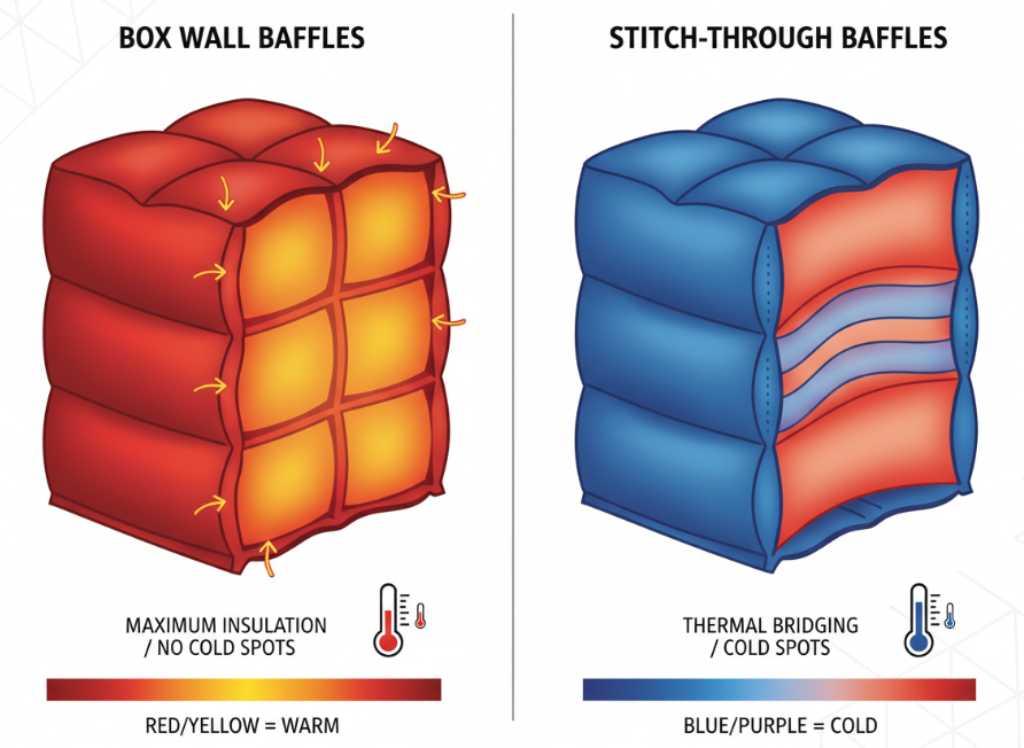
Box wall construction creates fully enclosed compartments with side walls, not just stitches. Picture a grid of boxes sewn between the inner and outer shell—each box holds down on all six sides (top, bottom, front, back, left, right).
Why box wall wins:
- More down per chamber: Wider baffles hold more grams of down, so you get maximum insulation without extra weight—just the right amount in each section.
- Fewer seams: Fewer dividing lines means fewer places for heat to escape through thermal bridging.
- Even distribution: The side walls prevent down from bunching, keeping consistent loft across the entire jacket.
The downside:
- Bulkier: The side walls and extra fabric add thickness and volume, making box-wall jackets harder to pack.
- More expensive: Extra construction and materials cost money—box-wall jackets start at higher price points than stitch-through.
- Overkill for active users: If you’re moving constantly and generating heat, you don’t need the maximum insulation box wall provides.
Who should buy box wall: Stationary cold-weather users (hunters in tree stands, mountaineers in camps), serious arctic/expedition gear, anyone planning extended exposure to -10°C or colder.
💰Save More with Our Discounts & Coupons!
Stitch-through: The compromise that creates cold spots
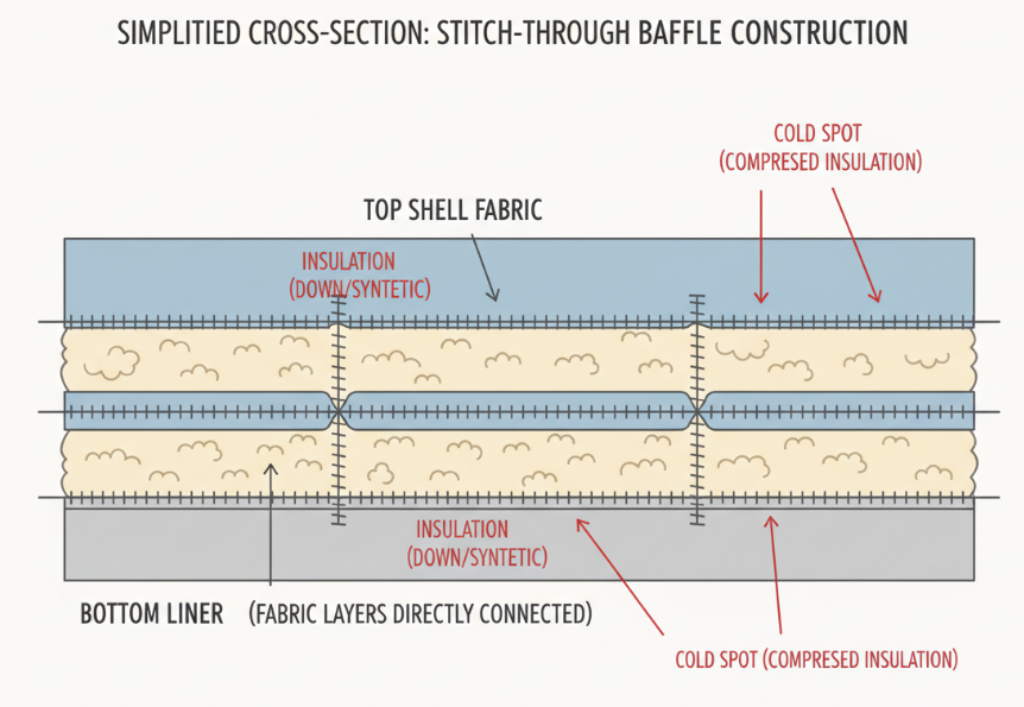
Stitch-through is the standard in most jackets because it’s cheap and effective enough. The outer fabric is stitched directly to the inner lining, creating horizontal rows of compartments separated only by thread.
How it works (and why it fails):
Down is compressed at every stitch line. At those seam points, the down loft collapses to essentially zero—you have fabric-to-fabric contact with little to no insulation. This creates what jacket manufacturers call “cold spots” or “thermal bridges.” Across a jacket, you might have 50-100+ stitch lines. That’s 50-100+ tiny thermal leaks.
Research on down-filled garment construction shows that stitch-through baffles reduce the optimum loft at each seam point, creating localized cold areas that compromise overall warmth.
Why brands use stitch-through anyway:
- Lighter: Uses less fabric and thread, so the final jacket weighs less.
- Cheaper: Much simpler to manufacture.
- Compressible: The lighter weight compresses better than box wall for backpacking.
- Adequate for most users: In continuous movement with proper layers underneath, the warmth loss is tolerable.
The real problem:
If you sit still—hunting, fishing, camping—you’re in trouble. You’re no longer generating body heat to compensate for the small insulation gaps at seams. That’s when cold spots become cold spots, and you feel shivering zones along the lines where down is pinched.
Who should buy stitch-through: Active users (hiking, skiing), budget shoppers, anyone who will keep moving and layer properly underneath, backpackers prioritizing pack weight.
Welded and bonded baffles: The rare premium option
Some high-end jackets use heat, chemicals, or adhesive to fuse fabric layers instead of stitching them. This eliminates the holes and needle perforations that stitch-through leaves behind.
Advantages:
- Maximum wind resistance: No stitch holes means no micro-gaps for wind to penetrate.
- Best water resistance: Water has nowhere to seep through at seams.
- Preserved loft: No down pinching at seams.
Disadvantages:
- Expensive: Much harder to produce.
- Fragile: Bonded baffles can degrade over time or with rough handling.
- Niche use: Mostly found in expedition/military gear.
Who should buy welded/bonded: Professional mountaineers, military field use, extreme expeditions where cost is not a limiting factor.
💰Save More with Our Discounts & Coupons!
Baffle width and compartment design: The hidden variable
Even within the same construction type, baffle size changes everything. The same box-wall principle applies to different compartment widths:
- Wide baffles (Standard/Macro): Hold more down, fewer seams, bulkier, warmer.
- Midi baffles (Medium): Good compromise between warmth and packability.
- Micro baffles (Narrow): Maximum compressibility, reduced warmth per gram.
Research on down jacket construction shows that different compartment widths allow the goose feathers to fill in different proportions, enabling manufacturers to customize warmth by body section.
Smart manufacturers use varying baffle widths within a single jacket:
- Wider baffles in the chest and back (high heat loss areas).
- Narrower baffles in the arms and shoulders (to maintain mobility without bulk).
This is why examining a jacket’s construction, not just reading a spec sheet, matters.
The cold spot trap: Why you feel cold at seams
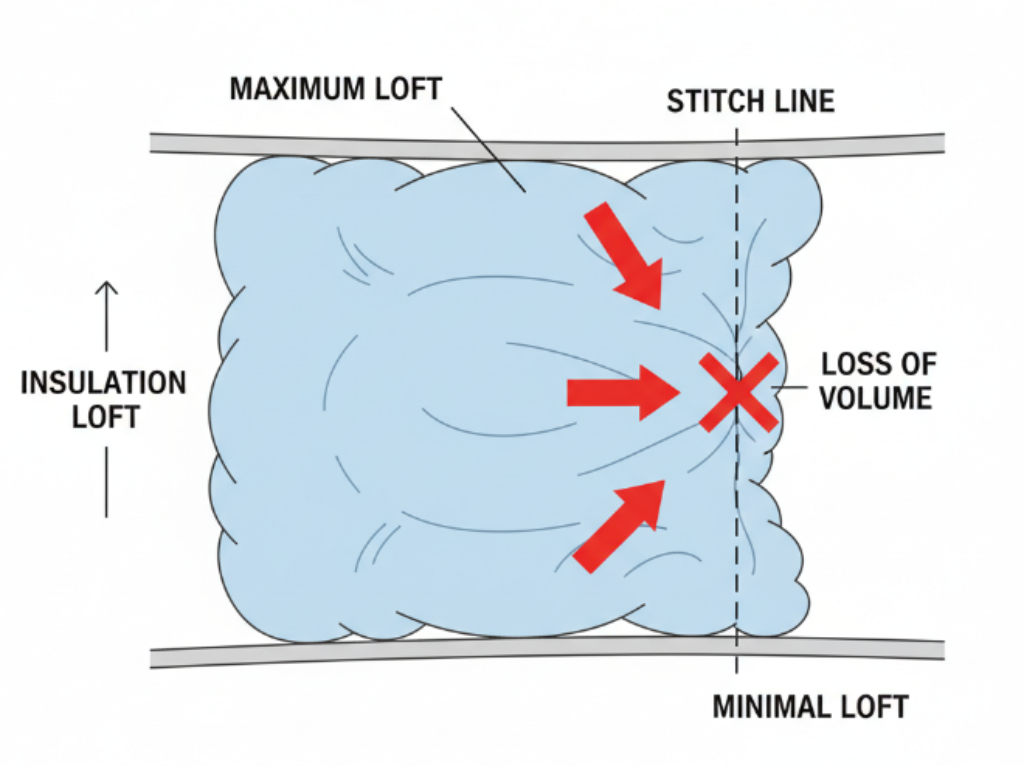
When down is pinched at a seam, it’s no longer trapping air—it’s pressed flat against cloth. In stitch-through jackets, this creates visible lines of coldness that correspond exactly to where the stitches run.
Real-world scenario: You’re hunting and sitting motionless for 4 hours. Your core temperature is dropping. You’re wearing a 700-fill stitch-through jacket under a shell. At the 2-hour mark, you start feeling cold along the horizontal stitching lines across your back and chest—not everywhere, just those lines. You’re warm between the seams but cold at them.
Why this happens: Without baffle side walls, the down can migrate slightly at stitch points, thinning the insulation layer. Combined with the fiber compression at the seam itself, you lose 30-50% of insulation right at the seam.
Box wall prevents this because the side walls contain the down everywhere, including at the edges, so loft is maintained more consistently.
Dealibrium Take: Baffle type vs. real-world use
Here’s how baffle construction translates into buying decisions, based on research on down-filled garments:
| Baffle Type | Warmth | Weight | Packability | Price | Best For | Avoid If |
|---|---|---|---|---|---|---|
| Box wall (wide) | Excellent | Higher | Poor | $$$ | Stationary cold users, hunters, mountaineers | You’ll be moving constantly and value lightweight |
| Box wall (midi/micro) | Very good | Moderate | Good | $$ | Versatile mountaineers, ski touring, alpine use | Budget is tight or you hate bulk |
| Stitch-through | Good (when moving) | Low | Excellent | $ | Backpackers, active users, budget shoppers | You sit still in cold for extended periods |
| Welded/bonded | Excellent | Moderate | Good | $$$+ | Expeditions, professional use, extreme cold | You need practical, cost-effective gear |
Dealibrium Take:
- For stationary use in cold: Box wall, especially with varied compartment widths.
- For active use: Stitch-through is adequate if you keep moving and layer underneath.
- For mixed use: Midi or micro baffle box wall offers a reasonable compromise.
💰Save More with Our Discounts & Coupons!
How to spot quality baffle construction when shopping
Since most jackets don’t publish detailed baffle specs, here’s what to check:
- Inspect the interior seams: Can you see stitch lines? That’s stitch-through. Are there visible side walls between seams? That’s box wall.
- Check for seam sealing: Quality stitch-through jackets seal seams on the inside to prevent down migration and water seepage.
- Look for varied baffle widths: Better jackets use wider baffles in the torso, narrower ones in the sleeves. This is thoughtful design.
- Feel the firmness and consistency: Press the jacket all over. Does it feel evenly fluffy? Or are there soft spots (indicating down migration) and stiff seam lines?
- Read the spec sheet carefully: Brands sometimes list construction type. Box wall, if mentioned, will be prominently featured because it justifies a higher price.
Frequently Asked Questions
In dry, controlled lab conditions, a heavy stitch-through jacket can match a lighter box-wall jacket’s warmth rating. But in real use—especially sitting still—box wall stays warmer because down doesn’t compress at the seams.
Depends on activity. If you’re hiking and generating heat, no. If you’re in a tree stand at -5°C for 6 hours, yes. The colder and stiller you are, the more you’ll feel the seam gaps.
Only if you’ll use it stationary in true cold. For backpacking or active mountaineering, you’re paying for unused features. Buy stitch-through and pocket the difference.
Stitch-through baffles hold up fine. Box wall can weaken if seams aren’t reinforced. Welded/bonded baffles can degrade if washed in hot water. Always follow the jacket care label.
Stitch-through: Yes, re-stitch a failed seam. Box wall: Much harder; you’d need to re-seal side walls. Welded/bonded: Usually not practical. Prevention (proper storage and care) is cheaper than repair.
Key Takeaways: Match Baffle Type to Your Reality
Box wall is warmer but heavier. Stitch-through is lighter but colder at seams. Neither is universally “better”—it depends on whether you prioritize weight or comfort in stillness.
Before buying, ask yourself honestly: Will I be sitting or moving? If sitting in cold, box wall saves you. If moving constantly, stitch-through’s weight advantage wins. And if you can’t decide, look for jackets with mixed baffle strategies: box wall in the core, stitch-through or micro baffle in the sleeves. That’s the smartest compromise.
The baffle you don’t notice is the one that’s working perfectly. The baffle you feel—as a cold seam line or a loose bunch of down—is the one that’s failed. Know what’s inside your jacket, and you’ll stop buying based on marketing and start buying based on physics.