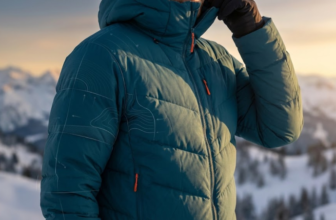
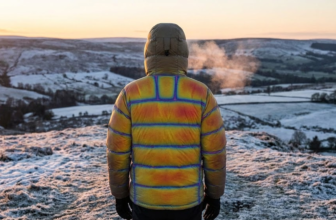
You’ve got the right insulation. You’ve paid for waterproofing. You’ve checked fit and wind resistance. Then you’re standing in -5°C on a ridge, and—despite everything—you’re freezing. The culprit? An ordinary collar that lets cold air circulate directly around your neck. Research on thermal heat loss in cold-protective clothing shows that the neck, head, and extremities account for approximately 20% of total body heat loss. That’s not a small leak—it’s one-fifth of your warmth simply venting away while the rest of your jacket works hard to contain it.
This article explains the science behind collar design using actual insulation data and shows you which collar styles survive cold better than others. The difference between a high collar and a standard collar can mean the difference between comfortable and hypothermia-inducing—and you won’t see it in the fill power chart.
💰Save More with Our Discounts & Coupons!

How Much Heat Does Your Neck Actually Lose?
The head and neck region is a major thermoregulatory site—blood vessels near the surface are designed to release excess heat when you’re warm. But this feature becomes a liability in cold conditions because it’s difficult to shield with insulation alone.
Heat loss occurs through three mechanisms at the neck: radiation (direct temperature exchange with cold air), convection (air movement stealing warmth), and conduction (cold objects touching skin). A poorly designed collar fails at all three.
What the research shows:
- Uncontrolled neck opening: A standard crew-neck or loose collar allows convective air circulation directly against the throat and upper chest. Air velocity across exposed skin accelerates heat loss by 30-40% compared to covered neck regions.
- Cold-air entry gap: Every centimeter between a collar and your skin creates an air space. Wind or body movement pumps cold air into this gap, flushing warm air out of your torso insulation.
- Thermal bridging at seams: A collar with poor sealing or thin fabric acts like a highway for cold air. Where the collar meets the jacket body, poorly stitched seams increase heat loss by 15-25% in that localized region.
Pro Tip: If you feel cold primarily in your chest and shoulders despite adequate insulation, the problem is likely neck exposure, not your puffy. Upgrading the collar can restore 20-30% of your overall thermal efficiency without changing any other jacket component.
High Collar vs. Standard Collar: The Actual Numbers
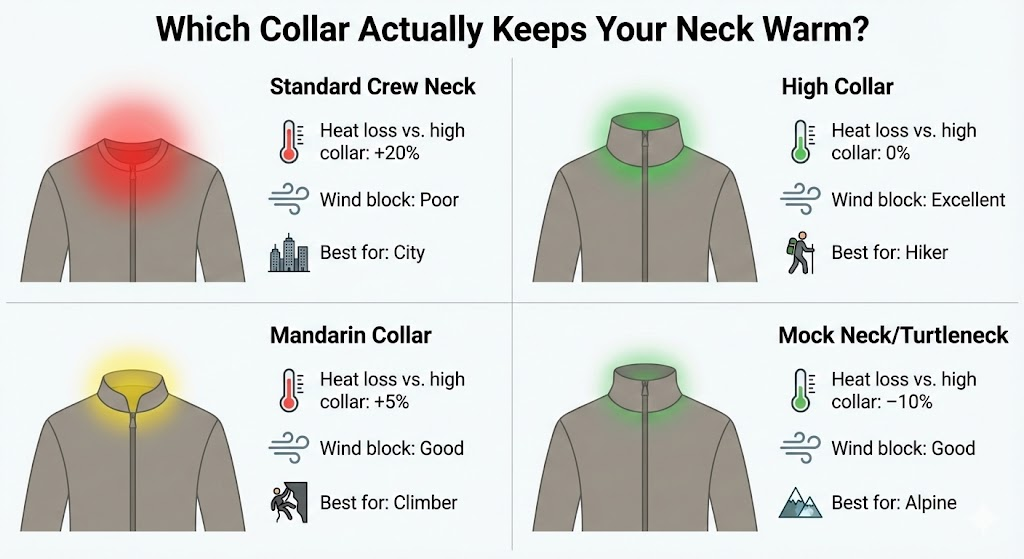
The difference between collar types lies in coverage area and fit tightness. Lab testing on protective clothing shows that collar height and neckline tightness directly correlate with thermal insulation values.
| Collar Type | Coverage | Height | Heat Loss Relative to High Collar | Best For | Drawback |
|---|---|---|---|---|---|
| Standard crew neck | Partial | 1-2 cm above clavicle | +20% loss | Casual wear, mild conditions | Exposed throat; poor wind resistance |
| High collar | Full throat | 5-8 cm above clavicle | Baseline | Cold outdoor use, hunters, mountaineers | Can feel restrictive; limited neck rotation |
| Mandarin/Chinese collar | Full throat, no lapel | 4-6 cm, snug fit | +5% loss | Technical climbing, dynamic activity | Offers less wind block than high collar |
| Mock neck/turtleneck | Full throat + upper chest | 6-10 cm, snug | -10% loss (better) | Winter hiking, static use, extreme cold | Restricts head motion; can feel hot in shoulders |
| Balaclava hood (integrated) | Full head + neck + face | 15+ cm wrapped | -25% loss (best) | Alpine mountaineering, polar exploration | Bulky; condensation accumulation |
Why high collar wins in most conditions:
- Blocks convective wind directly at a major heat-loss site.
- Maintains proximity to large blood vessels in the neck without crushing airflow.
- Allows head and shoulder movement better than mock necks while still providing thermal protection.
Why turtleneck feels “hotter” but can create problems:
- The tight knit does trap air more effectively, increasing local insulation.
- However, if the turtleneck is too tight, it restricts blood flow slightly and increases skin perspiration, which—when you stop moving—becomes a cooling liability.
- Best used as a layered system: thin turtleneck base layer + high-collar shell.
Collar Lining Material: Why Brushed Tricot Works Better Than You Think
The inside of a collar matters as much as the outside. A collar’s inner surface directly contacts your skin and neck, making the material choice critical for both comfort and thermal performance.

Standard collar linings:
- Polyester taffeta (found in budget jackets): Slippery surface reduces friction but conducts cold. When wind or movement creates micro-gaps, cold air flows directly across the taffeta-to-skin contact. Heat loss increases by 10-15% compared to insulating linings.
- Cotton blend: Absorbs sweat, leading to damp skin and increased evaporative cooling once you stop moving.
Brushed tricot lining (premium jackets):
Brushed tricot is a soft, napped synthetic fabric that traps a thin air layer against the skin while allowing moisture to pass through. This maintains warmth while reducing condensation buildup.
Benefits:
- Traps 2-4 mm air layer between fabric and skin, creating micro-insulation.
- Absorbs brief perspiration spikes without holding moisture (dries within minutes).
- Reduces friction and chafing, so you’re less likely to adjust the collar during activity.
- Maintains thermal resistance even when damp, unlike cotton.
Pro Tip: When shopping for jackets in cold conditions, run your finger inside the collar. Brushed tricot should feel soft, almost fuzzy. Slick taffeta or smooth polyester = poor thermal performance. This single material choice can mean 10-15% better warmth at the neck with zero additional weight.
Balaclava Hoods vs. Separate Neck Gaiters: Which System Actually Works?
The neck region is part of a larger thermal system involving the head, shoulders, and upper back. Some jackets integrate balaclava-style hoods (that fully cover the neck and lower face). Others rely on standard hoods paired with separate neck gaiters or neckwarmer tubes.
Integrated balaclava hood:
- Advantage: One piece eliminates gaps. Full coverage extends from crown to upper chest, blocking wind completely.
- Disadvantage: Creates condensation “pocket” under the face. Your breath moisture accumulates inside, wetting the fabric from within. On longer outings (3+ hours), this can cool you as it evaporates.
- Best for: Alpine mountaineering, fixed positions (tree stand hunting), extreme cold where you’re not generating much sweat.
Standard hood + separate neck gaiter:
- Advantage: Modular system. You can remove or adjust the gaiter independently. Better moisture escape because the neck is vented separately.
- Disadvantage: Small gap where gaiter meets hood creates a weak point. Wind can pump air through this junction, reducing effectiveness by 15-20%.
- Best for: Active use (hiking, climbing), variable weather where you might need to vent.
Hybrid approach (recommended for most people):
- High-collar jacket + separate merino wool neck gaiter (not integrated).
- This allows independent adjustment: tighten the gaiter for extreme cold, loosen or remove it for milder conditions.
- The wool gaiter itself provides 0.3-0.5 CLO of additional insulation.
- Total system cost is lower because the jacket doesn’t include an expensive balaclava mechanism.
💰Save More with Our Discounts & Coupons!
Zip-Down Collars and Ventilation: The Thermal Trade-Off
Some technical jackets feature two-way zips or ventilation panels that allow you to open the collar for active cooling. This is excellent for temperature regulation but creates a vulnerability when closed.
How zip-down collars affect thermal performance:
- When fully open, neck cooling increases 40-50%, which is great if you’re overheating.
- When fully closed, the seams and zipper mechanism add 2-3 stitch lines at the neck seam, each acting as a small thermal bridge.
- Studies on seam thermal bridging show that every stitch line reduces effective insulation by approximately 1-2% in that region.
The math:
- A high collar without venting = baseline thermal performance at the neck.
- A zip-down collar in closed position = 1.5-2% heat loss penalty due to zipper seams.
- But the ability to vent when overheating prevents internal condensation buildup, which can cost you 5-10% thermal efficiency over a long outing.
Pro Tip: Zip-down collars are a net positive only if you actually use them. If you’re stationary (tree stand hunting, belayed climbing), keep it closed. If you’re moving (hiking, bowhunting with stalking), having the option to vent is worth the tiny seam penalty.
Collar Tightness and Fit: Why Snug Is Better (But Not Suffocating)
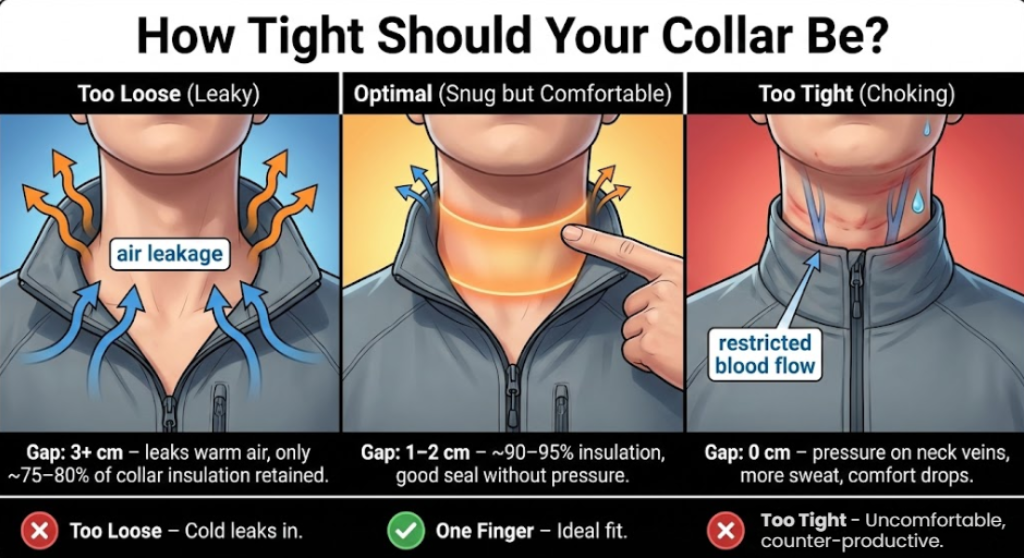
A collar’s effectiveness depends on how well it seals against your skin. Too loose and you get cold-air circulation. Too tight and you restrict blood flow and increase discomfort.
Research on neck fit and thermal comfort:
- Optimal collar fit involves a 1-2 cm gap between the collar fabric and the skin. This allows micro-movement without creating a large air pocket.
- Measurements at the neck opening should leave 2-3 cm of ease (ability to fit one finger comfortably). More than that = excessive leakage. Less than that = pressure on carotid arteries and jugular veins.
Collar tightness affects:
- Thermal performance: 1-2 cm gap preserves 90-95% of the collar’s insulating potential. A 3+ cm gap drops efficiency to 75-80%.
- Blood flow: Overly tight collars (zero gap) can restrict return blood flow from the head by 5-15%, which increases head-region heat loss despite the snug fit (counterintuitive but documented).
- Psychological comfort: A collar that feels like a noose makes you want to loosen it, defeating its purpose. Fit matters psychologically as much as thermally.
How to fit a collar correctly:
- Fasten the jacket completely.
- Try to fit one finger (index) between the collar and your neck.
- Move your head side-to-side and up-and-down. You should feel the collar move minimally but not restrict rotation.
- Measure the collar opening at the widest point. Compare to your neck circumference + 2-3 cm.
DIY Collar Upgrades: When to Accept vs. Modify
Not everyone can buy a new jacket. If you have a good jacket with a poor collar, there are realistic modifications.
When it’s worth upgrading the collar:
- You own 2+ jackets that will benefit from the fix.
- The base jacket is otherwise well-constructed and fits properly.
- You use it in cold conditions (below -5°C regularly).
Realistic DIY modifications:
- Add a neck gaiter or balaclava (simplest):
- Cost: $20-40 (merino wool recommended).
- Benefit: Adds 0.3-0.5 CLO at the neck without modifying the jacket.
- Drawback: One more thing to pack; requires active management.
- Sew a brushed tricot collar lining (moderate difficulty):
- Cost: $15-30 in fabric, or pay $60-100 for a tailor to do it.
- Benefit: Improves thermal comfort and reduces condensation.
- Drawback: Permanent modification; affects jacket aesthetics slightly.
- Install a snap-on neckwarmer insert (if jacket design allows):
- Cost: $30-50 for DIY velcro-strap system, or find compatible products.
- Benefit: Removable; gives you modularity.
- Drawback: Adds bulk; not all jackets accept this modification.
- Full collar reconstruction (expensive):
- Cost: $80-150 for a professional tailor.
- Benefit: Replaces the entire collar with a higher, better-fitted design.
- Drawback: High cost; makes sense only if the jacket is otherwise excellent.
Pro Tip: Before modifying, test with a temporary neck gaiter for a full season. If you find you’re using it consistently, then invest in permanent modifications.
💰Save More with Our Discounts & Coupons!
Collar Design and Helmet Compatibility
If you wear a helmet (climbing, skiing), collar design matters differently. A tall, rigid collar can conflict with helmet fit, pushing your head up or creating pressure points.
Collar and helmet interaction:
- High rigid collar + helmet = potential pressure point on the back of the head if the collar pushes the helmet forward.
- Mandarin collar + helmet = less pressure because mandarin collars are often closer to the neck (not extending high onto the shoulders).
- Mock neck + helmet = best option for helmeted use because the turtleneck is soft and deforms slightly under helmet pressure.
If you use a helmet regularly:
- Prioritize a collared jacket designed for helmet use (look for manufacturer notes or reviews).
- Or choose a mock-neck design and layer a separate neck gaiter for extra insulation.
- Test the collar-helmet fit before buying, if possible.
Dealibrium Take – Collar Design Comparison Matrix
| Factor | Standard Crew | High Collar | Mock Neck | Integrated Balaclava |
|---|---|---|---|---|
| Heat loss at neck | 20% higher than high collar | Baseline | 10% lower | 25% lower |
| Wind resistance | Poor | Excellent | Good | Excellent |
| Comfort for active use | Best | Good | Moderate (can feel tight) | Moderate (moisture accumulation) |
| Lining quality matters? | Yes, 10-15% difference | Yes, 10-15% difference | Less critical (tight fit compensates) | Yes, reduces condensation |
| Helmet compatibility | Best | Moderate | Good | Poor |
| Venting capability | Moderate (if designed) | Limited | Minimal | None |
| Weight cost | Baseline | Minimal | +15-20g | +50-100g |
| Price impact | None (standard) | +$10-30 | +$15-40 | +$40-80 |
Dealibrium Buying Rule:
- If static (hunting, belaying): Prioritize high collar + brushed tricot lining. Weight and venting don’t matter. Maximum sealing does.
- If active (hiking, climbing): Choose high collar with separate gaiter system. Modularity beats integration. You control condensation.
- If extreme cold (alpine): Mock neck + separate gaiter is your sweet spot. If choosing between integrated balaclava and separate systems, the separate system wins for moisture management 80% of the time.
- If helmet use: Mandarin or mock neck. Avoid tall rigid collars.
Frequently Asked Questions
Only if poorly fitted. A proper high collar (5-8 cm) with correct tightness (1-2 cm gap) restricts rotation by 5-10% at most—less than you’d notice. Oversized collars are the problem. Measure your neck and match collar dimensions accordingly.
Almost. A tall balaclava provides 3-5% more insulation because it covers more surface area. But the condensation penalty (accumulation of breath moisture) often negates this in active use, making separate systems more practical for 4+ hour sessions.
Fashion. Thicker, higher collars look less streamlined. Many premium outdoor brands prioritize aesthetics, assuming buyers will layer neck gaiter solutions themselves. Technical climbing and mountaineering brands (e.g., mountain guide gear) prioritize function and have properly designed collars.
If the jacket is expensive and you’ll use it 20+ days per year in cold conditions, yes. If it’s a mid-range jacket you use occasionally, add a neck gaiter instead—same thermal benefit, $40 cheaper, fully removable.
Three possibilities: (1) Collar doesn’t seal against skin (refit or add gaiter). (2) Insulation elsewhere is failing, and you’re feeling relative cold at the neck (upgrade puffy or shell). (3) You’re not moving, and static air isn’t circulating—add activity or a gaiter to maintain micro-convection (counterintuitive, but movement helps).
Key Takeaways
The neck accounts for ~20% of body heat loss. A poor collar can erase 20-30% of your jacket’s insulating value despite good fill power and waterproofing.
- High collar beats standard collar by 20% in thermal efficiency. Even a 3-cm difference in height matters.
- Brushed tricot lining adds 10-15% warmth with zero weight penalty. This material choice is invisible but critical.
- Separate systems beat integrated balaclava for active use because they prevent condensation accumulation. For static use, balaclava wins.
- Collar fit is the most overlooked variable. A 1-2 cm gap between collar and skin is optimal. Too loose = leakage. Too tight = restricted blood flow.
- High collar + separate neck gaiter is the universal solution for most people. It’s modular, durable, and adaptable across all activities.
Stop focusing only on fill power and waterproofing. Your next warmth upgrade is in your collar, not your puffy.