You see “600-fill” and “800-fill” on down jackets and sleeping bags, and every brand tells you the same thing: “higher is better.” The reality is more nuanced. Fill power changes warmth, weight, bulk, and price in very specific ways—and understanding it stops you overpaying for performance you will never use.
This guide uses lab data on down-filled clothing to decode fill power, down-to-feather ratios, and baffle design so you can pick the right jacket for your climate, not the most expensive one.
What fill power actually measures
Fill power is a standardized lab test that measures how much volume one ounce of down occupies under controlled conditions. A higher number means the down traps more air per unit weight, which is where warmth comes from.
In practice, 400–450 fill is budget, 600 is solid mid-range, and 750–900 is true premium. Higher fill power down is lighter for the same warmth, more compressible, and much more expensive.
Pro Tip: Treat fill power as a warmth‑to‑weight metric, not a warmth metric. A 600‑fill jacket can be warmer than an 800‑fill jacket if it simply uses more total down.
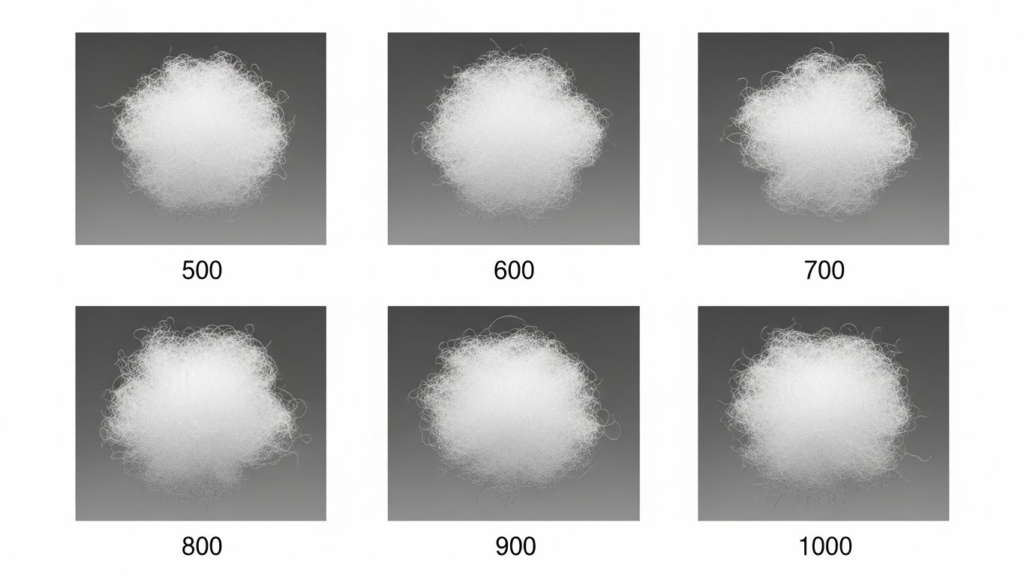
Why 600-fill and 800-fill feel so different
Down insulates by trapping air in a three‑dimensional lofted structure; the more loft per gram, the better the insulation. Lab work on down‑filled garments shows three main drivers of thermal insulation: fill power, total down weight, and the proportion of true down vs. feather.
- 600-fill down: Good loft, robust, widely used in winter jackets and sleeping bags; ideal for all‑round use where cost matters.
- 800-fill and above: Exceptional loft and compressibility; delivers the same clo (insulation) with significantly less weight and bulk, but at a steep price premium.
If two jackets have the same total grams of down, the 800‑fill piece will be warmer and lighter. But most brands reduce the fill weight in high‑fill jackets to save weight, so the real‑world warmth difference depends on both fill power and fill mass, not fill power alone.
💰Save More with Our Discounts & Coupons!
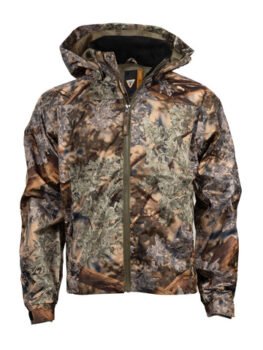
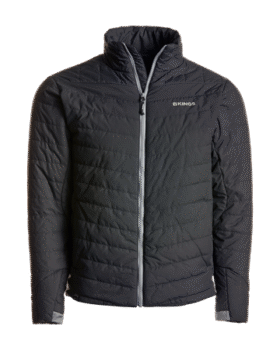
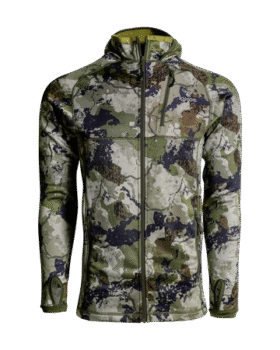
Down-to-feather ratio: the hidden spec that matters
Fill power is only half the story. Research on goose-down clothing shows that down‑to‑feather ratio significantly affects insulation.
- 90/10 down/feather: Premium; more true down clusters, higher loft, better warmth at lower weight.
- 80/20: Solid mid‑range; slightly heavier for the same warmth, but more affordable.
Feathers add weight and reduce effective loft because their quills don’t trap as much still air. In controlled tests, garments with higher down content at the same fill power achieve higher thermal resistance (higher clo).
Pro Tip: When comparing jackets, a 600‑fill 90/10 can outperform an 800‑fill 70/30 in real warmth if the cheaper fill uses more feather and less true down.
How baffle design makes or breaks warmth
Even perfect down loses most of its advantage if it is badly contained. Down products rely on baffles—compartments sewn or bonded into the shell—to keep the fill evenly distributed. Laboratory work on down-filled clothing confirms that baffle geometry, fill distribution, and construction directly control thermal resistance.
Key concepts:
- Wider baffles hold more down per chamber and need fewer seams, so they reduce heat loss through stitching.
- Narrow/micro baffles cut weight and bulk but increase the number of stitch lines, which act as cold bridges if the down is pinched at the seam.
- Uneven fill (under‑filled chambers or migration of down) creates cold spots that reduce real‑world warmth far more than a small difference in fill power.
Well‑designed baffle systems maintain consistent thickness across the garment, which the lab work correlates strongly with higher overall insulation.
Dealibrium Take: Fill power vs real-world use
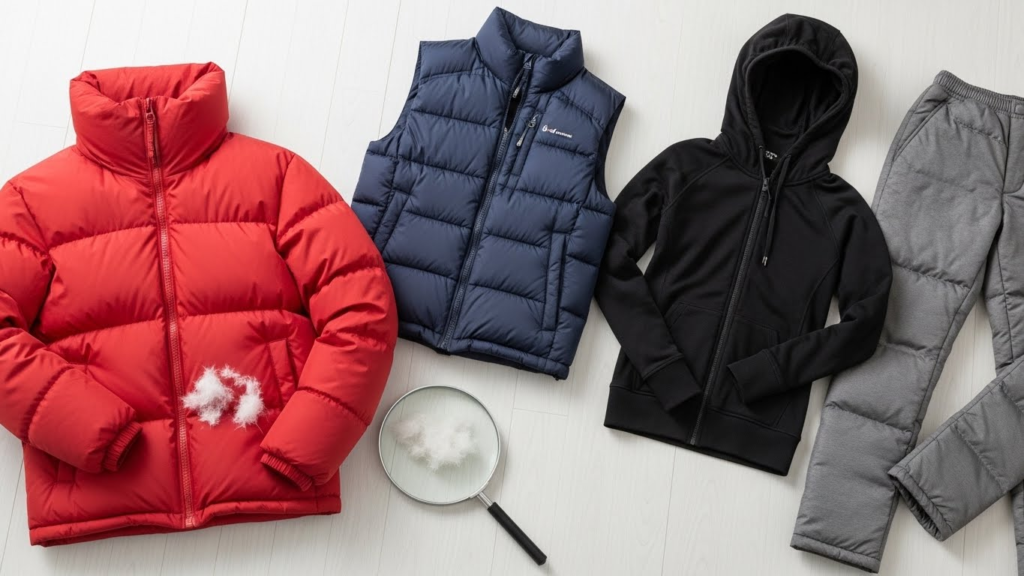
Here is how fill power, down ratio, and use case map out in the real world, based on the insulation research on down-filled clothing.
Down fill power and use-case guide
Dealibrium Take:
- Choose ~400–450 fill only if price is your top concern and weight/bulk don’t matter.
- Choose 600 fill for the best value: warm, durable, and affordable enough for most buyers.
- Choose 750–900 fill only if you genuinely need low weight and tiny packed size—for alpine trips, long thru‑hikes, or serious travel.
💰Save More with Our Discounts & Coupons!
How to choose fill power for your climate and activity

The insulation research shows that total clothing clo (insulation) is what keeps you comfortable—not a specific fill power number. The right spec depends on how cold, how long, and how still you will be.
Cold, dry city winters (down to about -5 °C)
- Ideal spec: 550–650 fill, 80/20 or better.
- Reason: You care more about cost and durability than shaving 150 g off your jacket. Properly filled 600‑fill with decent baffles is plenty for commuting and light walks.
Wet, variable climates (hovering around freezing, sleet/rain)
- Ideal spec: 500–650 fill paired with a good shell.
- Reason: In these conditions, water management and layering matter more than extreme fill power. A mid‑fill down or even synthetic layer under a waterproof shell often outperforms ultralight 800‑fill that risks wetting out.
Dry, very cold environments (below -10 °C, low wind)
- Ideal spec: 700–850 fill, 85/15 or 90/10.
- Reason: For extended time outside in severe cold, research shows high total insulation (clo) is crucial, and higher fill power achieves that with less weight and better comfort.
High-output mountain use (ski touring, fast hiking)
- Ideal spec: 700+ fill, but in a lighter, mid‑loft piece.
- Reason: You need something that packs small, warms fast during stops, and doesn’t add much weight to your pack. The models of clothing insulation and thermal comfort support using high-loft but lighter layers for active conditions.
Pro Tip: If you’re rarely below freezing for long, a well‑made 600‑fill jacket with good baffles is almost always the better buy than a more fragile, more expensive 800‑fill piece.
Frequently Asked Questions
Yes—if the jacket has enough total down and decent baffles. Research on down-filled clothing shows insulation depends on both fill power and fill weight, not fill power alone.
No. For the same weight, 800-fill is warmer, but many brands reduce the fill amount in high-fill jackets. In tests, total down mass and chamber design are just as important as fill power.
Often yes. Higher down ratios increase loft and reduce weight, improving thermal resistance at a given fill weight according to lab studies.
Wind can strip away up to 80% of insulation in cold protective clothing systems if not paired with a good shell, because convection dominates heat loss.
Use fill power to compare warmth per gram, down ratio to gauge quality, and baffle design to predict real-world warmth—then pick the cheapest jacket that hits the insulation level your climate demands.
Key Takeaways: Stop Chasing Fill Power Numbers
Fill power matters, but it’s only one piece of the puzzle. A 600-fill jacket with excellent down ratio and baffle construction will outperform a poorly designed 800-fill piece in real-world use. The brands that charge premium prices for ultra-high fill power often rely on consumer confusion—the assumption that “higher number = better jacket.”
The smarter strategy: Define your actual climate and activity, check the total down weight and down-to-feather ratio, inspect the baffle design, and then buy the cheapest jacket that meets your insulation target. A well-made 600-fill 85/15 jacket will serve you through decades of winters. An expensive 850-fill jacket with 70/30 down might leave you cold at seams and lighter in the wallet.
Stop shopping by fill power. Start shopping by real insulation value—warmth per dollar, durability, and baffle quality. That’s where your money actually matters.