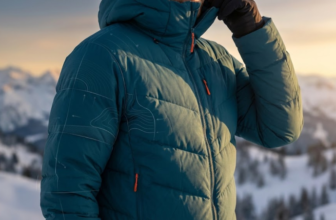
Your jacket is rated 800-fill down. Your friend’s is 600-fill. You’re both standing on the same cold ridge. Your friend feels warmer.
The difference isn’t the insulation. It’s the fit.
Thermal comfort doesn’t depend solely on what’s inside your jacket—it depends on how much of that insulation actually works. A jacket that fits properly traps air in the spaces between your body and the fabric. A loose jacket lets convective heat escape. A too-tight jacket crushes the loft, destroying the very air pockets that create warmth.
Research on clothing insulation shows that fit changes thermal performance by 15-25%, sometimes more. This means a properly fitted 600-fill jacket can outperform a poorly fitted 800-fill one. Most buyers don’t know this. Even fewer understand how to measure for fit.
This guide uses textile science and body morphology research to explain how fit amplifies—or destroys—insulation, then shows you exactly what measurements matter when buying jackets online.
💰Save More with Our Discounts & Coupons!
Why Fit Matters More Than You Think
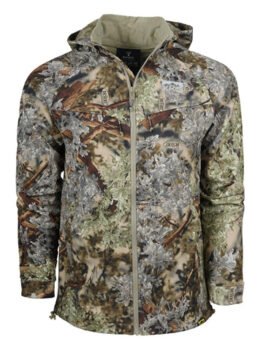
Thermal insulation works through trapped air, not through fabric alone. When air moves freely between layers or escapes around openings, your jacket loses its ability to maintain warmth. Fit controls whether that air stays still or gets flushed away.
Loose jackets pump air. When you move in an oversized jacket, the fabric flaps against your body. Each movement pushes warm air out and pulls cold air in. Research on dynamic clothing behavior shows that baggy garments can reduce effective thermal insulation by 20-30% compared to properly fitted ones, even when the insulation mass is identical.
Tight jackets crush loft. The opposite problem: compression reduces the air pockets inside insulation. Down and synthetic insulation work by creating dead-air spaces. When fabric presses against your skin or crushes the mid-layer, loft collapses, and those air pockets disappear. A compressed mid-layer loses 30-40% of its thermal resistance.
The fit sweet spot: moderate tension. Your jacket should fit close enough to trap air but loose enough to accommodate layers underneath and allow natural movement. Textile studies on protective clothing show this balance maintains 90-95% of the insulation’s theoretical performance.
Pro Tip: If you can pinch more than half an inch of fabric when the jacket is zipped, it’s too loose for serious cold. If you can’t raise your arms fully without tension, it’s too tight. The right fit lets you move freely and still maintain an air gap to your body.
The Measurement Problem: Why “Large” Doesn’t Mean You’ll Fit
Most buyers use chest circumference alone to choose jacket sizes. This is why so many people buy jackets that don’t fit.
Chest size is only one variable in a three-dimensional garment. Lab work on customized jacket patterns shows that proper fit requires measurements across five key dimensions: chest, lateral side width, shoulder width (interscye), sleeve length, and back length. Off-the-rack jackets are designed to a single body profile. Your body may not match that profile.
The lateral side width problem: The fabric on the sides of your torso should measure 49-51% of your constructive bust allowance. This controls how the jacket drapes and where insulation sits. A wider side panel moves the jacket away from your body, creating gaps. A narrower panel pulls it too close, potentially crushing down.
Most brands don’t publish this measurement. You’re left guessing.
Interscye (shoulder) measurement: This is the distance between the inside of one armpit to the inside of the other, measured across the back. It determines whether your shoulder point aligns with the jacket’s designed shoulder seam. A 2-inch difference changes how the entire jacket hangs and where gaps form around your arms.
Research on body morphology shows that shoulder width varies significantly even among people with identical chest sizes. A person with a 40-inch chest might have shoulders that require a 17-inch interscye, while another person with the same chest needs 18.5 inches. This 1.5-inch difference affects thermal performance because it changes how the arm and shoulder insulation aligns with your body.
How Body Shape Changes Fit Needs
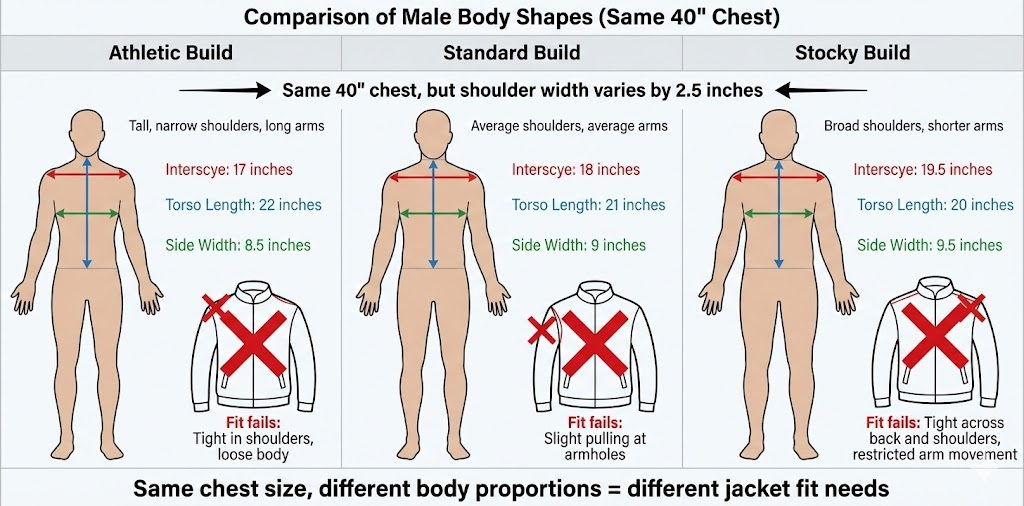
Your body morphology—bone structure, proportions, and where muscle sits—directly influences which jackets will fit well.
Age affects fit: Research comparing jacket patterns across age groups shows that a 35-year-old man and a 50-year-old man with identical chest measurements often need different patterns. The older person typically has a longer torso and different shoulder slope. Pattern adjustments of 1-3 cm in key areas become necessary.
Body shape varies widely: A person built for climbing has different proportions than someone built for sitting in a tree stand. This isn’t about size—it’s about how your bones are arranged. A study on customized jacket design found that successful fit required accounting for factors like:
- Neck-point to waistline distance: How long your torso is relative to your height
- Shoulder slope: How much your shoulders drop or square up
- Arm length relative to torso: Affects sleeve fit and shoulder seam placement
- Back width: Determines how much space the jacket needs across the shoulders
A single “size M” or “size L” can’t accommodate these variations. This is why two people in the same nominal size often have completely different experiences with the same jacket.
The Fit-and-Thermal Connection: Why Measurements Protect Your Insulation
Proper fit maintains the clothing area factor (f_cl)—a measure used in thermal insulation studies. The f_cl value indicates how much body surface area is covered by clothing. When fit is loose, air circulates between the clothing and skin, increasing heat loss. When fit is right, the f_cl value stays high, keeping insulation effective.
Lab testing on thermal insulation shows:
- Properly fitted layers maintain 95-98% of their rated thermal resistance
- Loose layers (more than 1 inch of excess fabric) lose 20-30% of effectiveness
- Compressed layers (crushed loft) lose 30-40% of effectiveness
- Moderate fit with 0.5-1 inch of space maintains 90-95% of effectiveness
What this means: A loose 800-fill jacket and a properly fitted 600-fill jacket often deliver identical warmth. The fit, not the fill power, becomes the limiting factor.
💰Save More with Our Discounts & Coupons!
How to Measure for Jacket Fit (The Right Way)
Most online retailers give you only two measurements: chest and length. These are insufficient. Use this checklist before buying:
1. Chest circumference (what they always provide)
Measure around the fullest part of your chest, keeping the tape parallel to the ground. This is the standard, but it’s incomplete.
2. Back width (ask the brand, they often measure this internally)
Measure from shoulder point to shoulder point across your back. Most jackets list this as “shoulder width.” If they don’t publish it, request it from customer service. A 1-2 cm difference changes everything.
3. Torso length (from collar point to waistline)
This determines whether the jacket will sit at your natural waist or ride up. Too short, and it bunches. Too long, and gaps form at your hips when you raise your arms.
4. Sleeve length (shoulder seam to wrist)
Measure from the back of your neck, across your shoulder, down to your wrist with your arm slightly bent. Most brands measure this incorrectly.
5. Side width (when possible)
Wrap a measuring tape around your torso at the widest point, without pulling tight. Compare this to the jacket’s side panel width. A difference greater than 2 inches usually signals a fit problem.
Dealibrium Take: How Fit Grade Your Jacket’s Thermal Performance
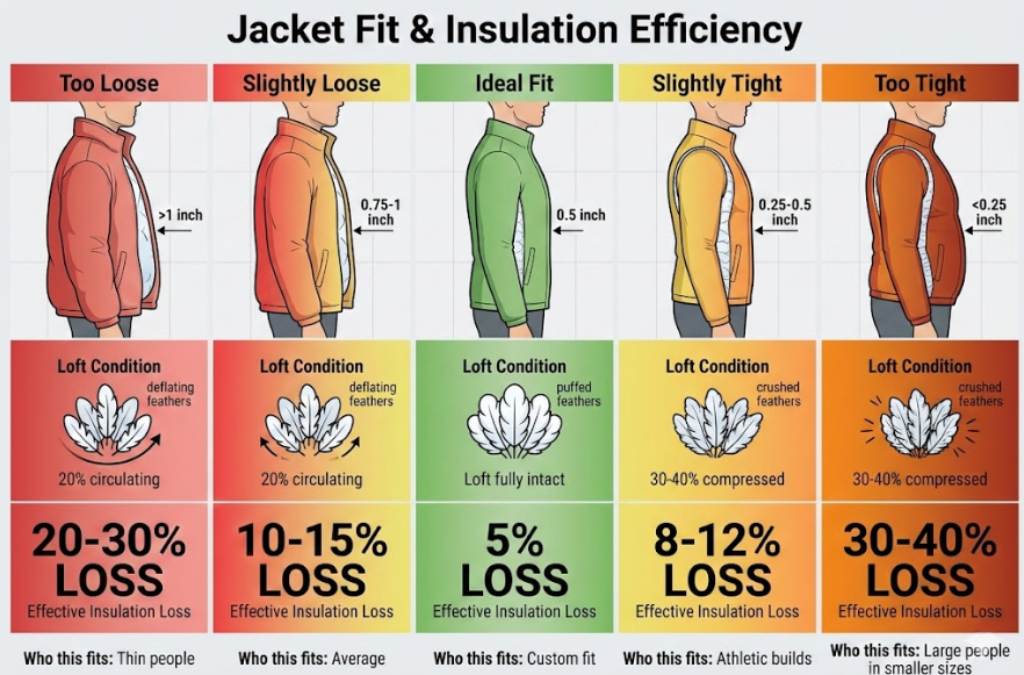
| Fit Category | Air Gap at Body | Loft Condition | Effective Insulation Loss | Who This Fits |
|---|---|---|---|---|
| Too Loose | >1 inch | Mostly intact but air circulates | 20-30% loss | Thin people wearing standard sizes; oversized jackets |
| Slightly Loose | 0.75-1 inch | Intact, minor circulation | 10-15% loss | Average fit, most people buying standard sizes |
| Ideal Fit | 0.5 inch | Fully intact, minimal air movement | 5% loss | Custom or careful sizing |
| Slightly Tight | 0.25-0.5 inch | Minor compression of loft | 8-12% loss | Athletic builds in standard sizes |
| Too Tight | <0.25 inch | Significant loft collapse | 30-40% loss | Large people in smaller sizes; layering crushed |
The Dealibrium Rule: If your jacket lets you pinch more than an inch of fabric at the ribs and you can still raise your arms fully without tension, it’s probably losing 15-20% of its insulation to air circulation. A firm fit—where you can pinch about 0.5 inches—maintains 90%+ of thermal performance.
Why Online Shopping Fails at Fit
Retailers publish chest and length measurements. They rarely publish interscye, side width, or back length. This is intentional: it simplifies inventory and returns processing. But it means you’re buying blind.
The consequence: Many buyers purchase based on chest size alone, receive a jacket that fits poorly, feel it doesn’t perform, and return it. The jacket wasn’t bad—the fit was.
Strategic workaround for online shopping:
- Check return policies first. Buy from retailers with free or low-cost returns. You’ll likely need to try multiple sizes.
- Request detailed measurements before buying. Email the brand and ask for chest, shoulder width (interscye), torso length, and side width. Brands that ignore this request are signaling they don’t prioritize fit.
- Compare to a jacket you own and love. Lay it flat, measure its chest width, shoulder width, and length. Search for brands with identical measurements. Many brands maintain consistent fit across models.
- Watch for fit reviews on retail sites. If 30% of reviews say “runs large” or “sleeves too short,” that’s data. Adjust your size choice accordingly.
- Ask about body morphology. If you’re taller but narrower than average, or have unusually long arms, mention it to customer service. Brands that stock multiple fits (regular, tall, athletic) can often recommend a better option.
💰Save More with Our Discounts & Coupons!

FAQ: Fit and Thermal Comfort
Yes. Fit solves circulation and compression problems, but it doesn’t change how much insulation is in the jacket. A 400-fill jacket in a perfect fit will still be colder than an 800-fill jacket in a perfect fit. Fit is a multiplier, not a replacement. It amplifies good insulation and wastes poor insulation.
Yes, but carefully. You need 1-1.5 inches of extra space around your torso to fit a mid-layer without crushing it. However, this only works if the rest of the jacket (shoulders, sleeves, length) still fits properly. Many people buy one size too large in all dimensions to accommodate layers, which creates too much excess in the shoulders and sleeves. Better strategy: measure with the mid-layer on, or choose a brand that offers “fit for layering.”
In controlled lab conditions, no. A poorly fitted 800-fill jacket has more total insulation mass than a perfectly fitted 400-fill. But in real-world movement, the gap narrows. Field data on hunters and mountain users suggests that fit differences can negate 200-300 fill-power points. A well-fitted 600-fill can match or beat a poorly fitted 800-fill in sustained wear.
You can’t, unless you measure. This is why fit failure is so common online. A jacket can fit your chest perfectly but have shoulders that are 1.5 inches too wide or too narrow. If possible, try jackets on in person to establish baseline measurements. Then, when buying online, confirm the shoulder width (interscye) matches.
Partially. Compression from a pack crushes the insulation on your back, reducing its performance. Research on backpack-wearing shows that back insulation loses 30-40% of effectiveness under pack pressure. This is why many hunters and backpackers wear a lightweight shell jacket over a puffy, rather than a thick, bulky puffy. The puffy compresses anyway, but the thin shell protects you from wind regardless.
Key Takeaways
Fit affects thermal insulation by 15-25%. A properly fitted jacket with moderate insulation often outperforms a poorly fitted one with heavy insulation. Fit is not a luxury—it’s a performance variable.
Chest measurement alone is insufficient. Buy jackets based on chest, shoulder width (interscye), torso length, and side width. Most online retailers don’t publish these, so ask.
Your body morphology matters. Shoulder width, torso length, and arm proportions vary widely. A single size doesn’t fit everyone with the same chest measurement. Expect to try multiple sizes or brands.
Moderate tension is the goal. You should be able to pinch about 0.5 inches of fabric when the jacket is zipped. Loose jackets waste insulation through air circulation. Tight jackets waste insulation through loft compression.
Online shopping requires strategy. Request detailed measurements, check return policies, watch fit reviews, and compare to jackets you already own. The first jacket you order may not fit—plan for returns.