Every year, thousands of hunters venture into wilderness expecting to find game. Most return safely. But when something goes wrong in the backcountry—a fall from a stand, a bleeding wound, unexpected hypothermia, or becoming disoriented—the outcome depends entirely on what’s in your pack before you leave the truck.
The uncomfortable truth: it’s not the spectacular emergencies that kill hunters. It’s the slow ones. Hypothermia claims more lives than trauma. Getting lost claims more than bleeding. Yet hunters consistently pack for the wrong disasters and ignore the science that would save them.
This guide translates survival research and wilderness medicine into actionable decisions. Unlike generic survival guides, we’ll focus on what actually kills hunters and what gear actually works in field conditions—based on emergency response data and trauma medicine.
Can a Tourniquet Really Stop Bleeding on an Extremity?
A tourniquet is the single most effective bleeding control tool you can carry. Military research is unambiguous: hunters who apply a tourniquet before going into shock survive 96% of the time. Those who delay until shock develops? Only 4% survive. That’s not anecdotal. That’s medical fact from 862 documented cases.
Here’s the mechanism: when a major artery in your arm or leg is severed—whether from a fall, a knife accident during field dressing, or a firearm incident—you lose blood exponentially. Within minutes, your blood pressure plummets (shock). Your body goes into survival mode but it’s already too late for most other interventions. A tourniquet applied in the first 5 minutes, however, completely stops that bleed and buys you time for rescue.
The survival difference between early and late application is so dramatic that military medical teams abandoned the old doctrine of “use tourniquets as a last resort.” Now the protocol is: apply first, ask questions later, if major extremity bleeding is present.
Dealibrium Take: Your first aid kit isn’t complete without a tourniquet rated for your arm/leg. The Combat Application Tourniquet (CAT) has a 92.2% correct application rate in untrained hands—significantly higher than other models. Weight: 2 oz. Cost: $25-30. The return on investment is your life.
What Should Be in Your Hunting First-Aid Kit? The Unfiltered Checklist
Most “complete” first aid kits are bloated. They contain items you’ll never use and miss items you desperately will. A better approach: organize by likelihood and severity.
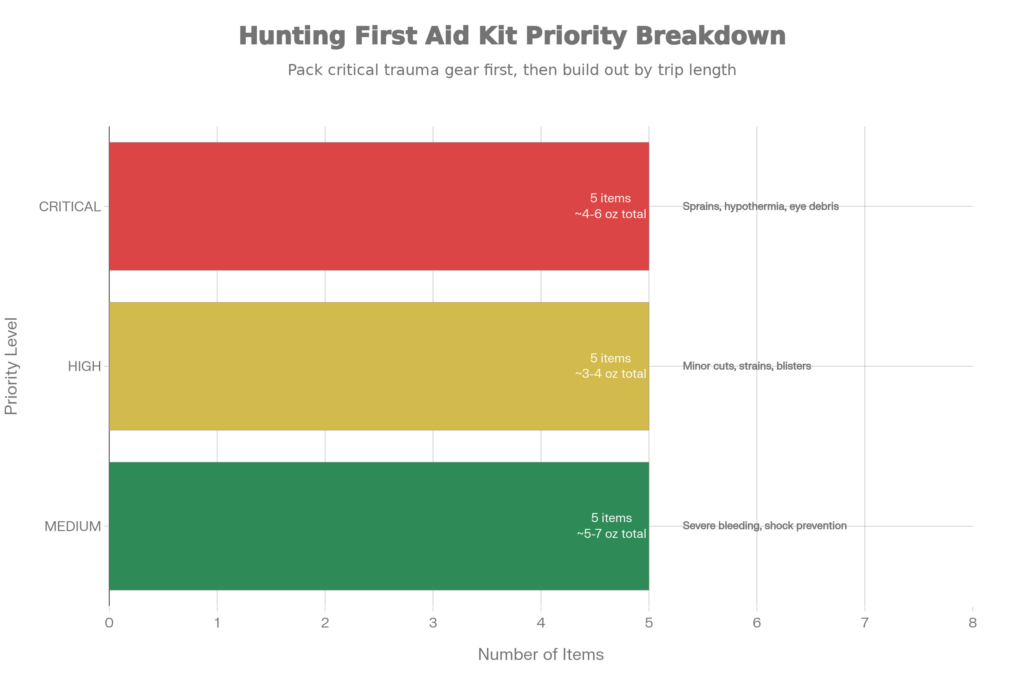
The critical tier addresses the scenarios that kill fastest—uncontrolled hemorrhage and shock. If you’re bleeding out from a severed femoral artery, antibiotic ointment won’t save you. A tourniquet will.
The high-priority tier covers what actually happens in the field: minor cuts during game processing, blisters from rough terrain, splinters, and tick removal. These injuries won’t kill you but they can escalate into infections if untreated.
The medium tier is for extended hunts where you’re farther from help. An emergency blanket weighs nothing but it’s the fastest way to prevent hypothermia if you’re stuck overnight. A SAM splint turns an ankle sprain from “hike out in agony” into “hike out with support.”
Pro Tip: Don’t buy a pre-assembled kit. Most include items chosen for medical comprehensiveness, not field reality. Build your own. Start with the critical tier (tourniquet, hemostatic gauze, gloves, sterile dressings), add the high-priority items, and supplement based on your specific hunt (remote multi-day? Add the medium tier. Day hunt within 5 miles of truck? Skip it).
Fire-Starting: Why Your Lighter Isn’t Enough
Picture this: you’re lost, it’s getting cold, darkness is falling. You reach for your waterproof matches. Your hands are shaking. You strike once… nothing. Twice… the match head snaps off. By the fourth attempt, you’ve burned through half your matchbox and still have no fire.
This is the difference between having fire-starting tools and reliably starting a fire. Wet conditions, fatigue, cold fingers, and panic all degrade your ability to ignite tinder. Professional survival instructors and search-and-rescue teams don’t rely on a single method—they carry redundancy.
The science: moisture is your enemy. Even “waterproof” matches fail if the striking surface gets damp or if you’re trying to light damp wood in humid conditions. Standard lighters work reliably in dry conditions but fail in extreme cold or high winds. Ferro rods (flint and steel) work in wet conditions but require more skill and stronger tinder to succeed.
Which fire starter should you carry? All of them. Or at minimum: a reliable primary (BIC lighter—yes, really, they work 99% of the time) plus a backup (ferro rod or flint and steel) plus a fuel substance that burns in wet conditions.
What’s the Best Fuel When Everything Is Wet?
Pyro Putty (15-minute burn time per quarter-sized ball) and Survive Outdoors Longer Fuel Cubes (8-minute burn time) are the two products recommended by wilderness guides and military survival instructors. Both burn hot enough to ignite damp wood and don’t depend on existing tinder.
The budget alternative that works: petroleum jelly-soaked cotton balls in a ziplock bag. The burn time is comparable to Pyro Putty. The cost is pennies. The downside: messier and requires careful storage so the jelly doesn’t leak into your pack.
Dealibrium Take: Your fire kit should be small enough to fit in your cargo pocket: BIC lighter, 10-15 cotton balls soaked in petroleum jelly (in a sealed baggie), and a ferro rod with striker card. Total weight: 2-3 oz. Total cost: under $15. This combination handles dry tinder (lighter), wet conditions (fuel balls), and emergency situations where your main lighter fails (ferro rod). Three methods. Three chances to survive the night.
💰Save More with Our Discounts & Coupons!
Navigation Without Power: Maps, Compass, and GPS Trade-Offs
Why Your GPS Dies But Your Compass Never Will
Modern hunters love GPS. It’s precise, automatic, and gives you a blue dot on a screen. Right up until the batteries die, it gets wet despite being “waterproof,” or you lose signal under heavy tree canopy. Then it becomes a 6-ounce paperweight.
A compass never dies. It has no batteries, no electronics, no failure modes except being dropped in a river. A topographic map of your hunting area, folded and waterproofed in a gallon ziplock bag, also never fails. These two tools—map and compass—have kept backcountry travelers alive for centuries.
But GPS is genuinely faster and more accurate for complicated terrain, especially in thick brush or fog. So the answer isn’t “map and compass only.” It’s GPS first, map and compass as proven backup.
Here’s the hierarchy from experienced backcountry hunters:
- GPS primary (Garmin inReach Mini 2, onX Hunt app, or similar) for real-time tracking and waypoint marking
- Offline maps downloaded to your phone (onX Hunt, GAIA GPS) as secondary backup
- Topographic paper map + baseplate compass as tertiary backup (no batteries ever needed)
The critical step most hunters skip: before your hunt, identify major landmarks, water sources, and your vehicle location on the map and mark waypoints on your GPS. If everything else fails, you can navigate off landmarks memorized from the map.
PLB vs. Satellite Messenger: Which Device Should You Actually Buy?
This is where many hunters get confused. Personal Locator Beacons (PLBs) and satellite messengers sound similar. They’re fundamentally different in capability and philosophy.
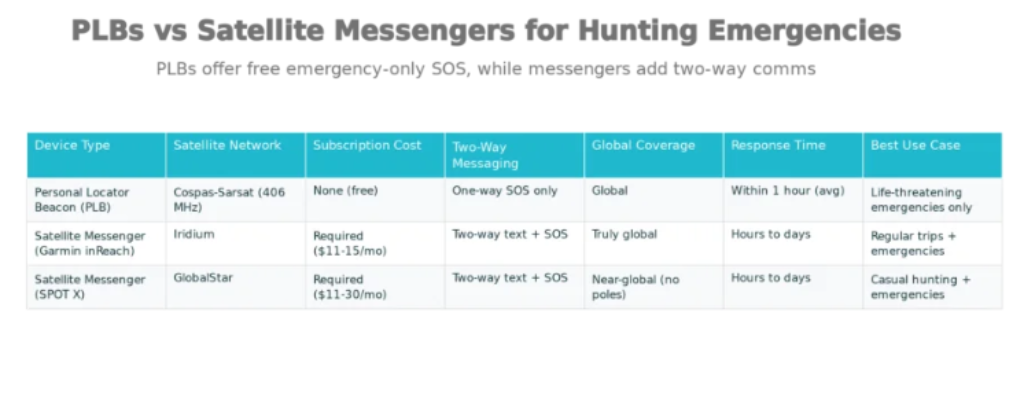
PLBs are designed for one scenario: “I’m going to die unless someone rescues me right now.” You press the button. It sends a continuous distress signal via the Cospas-Sarsat satellite network. Your GPS coordinates transmit to search-and-rescue teams. You cannot cancel the signal once activated. Rescue will be dispatched. No subscription. Simple. Effective. One-time use emergency tool.
Satellite messengers are designed for the entire trip experience. Two-way messaging lets you tell family you’re safe, ask for logistical help, or coordinate a rescue with more detail than a PLB allows. They cost $11-15 monthly but give you communication security throughout the hunt. Garmin inReach models offer real-time GPS tracking, weather updates, and the ability to cancel a false alarm.
For backcountry hunts beyond cell range, which do you need? The answer depends on three factors:
- Distance from civilization: Day hunts within 5 miles? Cell phone backup is often sufficient. Multi-day hunts 15+ miles out? A satellite device becomes essential.
- Predictability of your location: Are you hunting established areas with known access routes or exploring uncharted terrain? Predictability means rescue is faster without two-way communication.
- Risk tolerance: PLBs are cheaper up-front ($150-200) but offer only “emergency yes/no.” Satellite messengers cost more monthly but let you manage situations before they become emergencies.
Dealibrium Take: If you hunt the same territory repeatedly and are comfortable with wilderness conditions, a PLB covers the catastrophic scenario. If you’re exploring new country, hunting solo in remote areas, or value real-time family communication, a satellite messenger justifies the monthly cost. The Garmin inReach Messenger Plus is the gold standard for messaging and tracking, though it costs $249 upfront. For budget-conscious hunters, the SPOT Gen 4 ($149) is adequate for basic SOS and check-in functions.
Why Do Hunters Die From Hypothermia When It’s 50°F Outside?
Hypothermia doesn’t require sub-zero temperatures. It requires three conditions: moisture, wind, and fatigue. The classic scenario: you’re hunting in cool, damp weather. You work hard traversing terrain, sweat through your base layers. Wind picks up. You’re now wet, the wind accelerates evaporative cooling, and your body can’t generate heat fast enough to compensate. Core temperature drops. Thinking becomes fuzzy. You make poor decisions. You lie down to rest and never get up.
This is so common that hypothermia kills more hunters than trauma. Most hunting injuries are traumatic (falls, gunshot wounds). Most hunting deaths are environmental—exposure.
The prevention is brutally simple: stay dry. The moment you feel dampness (from sweat or rain), take action:
- Stop and change your base layer if it’s wet. Store a dry spare in a waterproof bag. Yes, this slows you down. It also keeps you alive.
- Add insulation layers before you get cold (not after). Shivering is your body’s warning that thermoregulation is failing.
- Eat high-calorie food constantly: chocolate, nuts, peanut butter, energy bars. Your body is a furnace that needs fuel. In cold weather, feed it aggressively.
- Never eat snow or ice to quench thirst. Your body must burn calories to melt it, which accelerates heat loss.
From Experience: A hunter in a wet base layer at 45°F loses core heat 25 times faster than in dry clothes. This isn’t about comfort—it’s about survival. Changing clothes takes 10 minutes. Hypothermia can incapacitate you in 45 minutes.
💰Save More with Our Discounts & Coupons!
How Do You Recognize Hypothermia Before It’s Too Late?
Early hypothermia is obvious once you know the signs. The problem: these signs feel normal until they’re critical.
- Uncontrollable shivering: Your body trying to generate heat. This is your warning signal.
- Slurred speech and poor coordination: You’ll feel clumsy, “drunk.” Others will notice before you do.
- Irrational thinking: A person with hypothermia might refuse help or want to lie down in snow. This is a medical sign, not stubbornness.
- Euphoria: In severe cases, victims feel a false sense of well-being. They stop caring about survival. This is extremely dangerous.
The treatment for mild hypothermia:
- Get to shelter or behind wind-blocking terrain.
- Remove wet clothing immediately. Replace with dry layers.
- Build a fire. Dry out one layer at a time (don’t try to dry everything simultaneously).
- Drink warm fluids (not alcohol). Eat high-calorie food.
- Rest for 30+ minutes before continuing.
If someone shows moderate hypothermia (can’t walk properly, confusion), they should not stand or walk—evacuation must be gentle. If someone is unconscious and severely hypothermia, they need medical care. Call for help.
What gear prevents hypothermia emergencies?
- Emergency blanket: A lightweight, reflective space blanket (less than 1 oz) reflects your body heat back. Carry one always. It’s not a shelter, but it’s instant insulation in a crisis.
- Dry base layers in waterproof bag: The single most important prevention tool.
- High-energy food: Doesn’t weigh much and keeps your furnace running.
- Hat: Most heat loss occurs through your head. A simple knit hat (1 oz) is essential.
How Do You Survive an Unexpected Night Without a Tent?
The principle is simple: ground insulation is critical. Most hunters die in shelters that fail because they’re lying directly on cold ground. Soil, rock, and grass conduct heat away from your body directly into the earth—a process called conduction. You could be in a perfectly insulated cave and still hypothermia to death if you’re sleeping on bare ground.
The immediate action if you’re stranded overnight:
- Gather insulation material: Leaves, pine needles, dry grass, bark—anything with loft that traps air. Create a thick bed (12+ inches) between your body and the ground.
- Build windbreak: Even a small wall of branches, rocks, or a tarp blocks wind, which accelerates heat loss. Position yourself so the wind doesn’t hit you directly.
- Stay active until shelter is ready: Physical activity generates heat. Stop only when your shelter is prepared.
For multi-night emergencies in winter terrain, a snow cave or quinzhee offers superior insulation. Dig into a stable snowdrift (avoiding loose, wind-scoured snow) and create a sleeping platform 6-12 inches above the entrance so cold air pools below you. Maintain at least one ventilation hole to prevent carbon dioxide buildup.
Here’s the survival statistic that matters: 90% of lost hunters survive. If you stay alive for 2 days and prevent hypothermia, your survival odds jump to 97%. This means your emergency kit doesn’t need to enable a week-long bushcraft journey. It needs to keep you alive for 48-72 hours until rescue arrives.
Your Complete Hunting Emergency Kit: What to Carry and Why
Most hunting first aid and survival kits are designed by medical professionals (comprehensive) or outdoor gear companies (expensive). They don’t reflect what hunters actually use in the field.
The reality: hunters use signaling devices, fire starters, and map/compass 100x more often than tourniquets. But tourniquets save lives in the 1 scenario where everything else fails. This is why your kit should be small and light with essentials prioritized by life-threatening potential, not likelihood.
The complete field kit for backcountry hunts (fits in a small stuff sack):
Bleeding Control (trauma tier):
- 1 CAT 7 tourniquet
- 1 Israeli pressure bandage or combat gauze
- 1 emergency chest seal
- 2 pairs nitrile gloves
- 2-3 sterile gauze pads
Wound Care (field tier):
- Adhesive bandages (assorted sizes)
- Tweezers (tick/splinter removal)
- Antibiotic ointment packet
- Antiseptic wipes
- 4-6 feet duct tape (wrapped on card)
Pain & Discomfort:
- 4-6 ibuprofen tablets
- Blister treatment/moleskin
Environmental Protection:
- 1 emergency space blanket
- 1 knit hat (if not wearing already)
- Dry base layer (in waterproof bag)
Navigation & Signaling:
- Compass + topographic map (waterproofed)
- Whistle (heard from 1+ mile away, unlike voices)
- Small mirror (daytime aerial signaling)
- Headlamp + extra batteries
Fire & Shelter:
- BIC lighter
- Ferro rod + striker card
- 10-15 petroleum-impregnated cotton balls (in ziplock)
- Large garbage bag or lightweight tarp
Communication:
- Cell phone (in waterproof case, even if no service)
- PLB or satellite messenger (if remote area)
Total weight: 2-3 lbs. Total cost: $150-300 (one-time for most items; satellite devices have monthly fees).
💰Save More with Our Discounts & Coupons!

Does Blaze Orange Actually Prevent Hunting Accidents?
Yes. Dramatically. In the 20 years before 2010, 81% of victims in vision-related hunting incidents were not wearing hunter orange. By contrast, hunters wearing orange are seven times less likely to be shot.
The physics is straightforward: blaze orange (International Hunter Orange #DD3107) is the most visible color to the human eye in natural lighting. Camo patterns blend into forest. Orange stands out 400+ yards away.
The good news for deer hunters: deer can’t see orange. Research confirms deer see in the blue-yellow spectrum but not red or orange. They perceive orange as a dark neutral tone—invisible to them. So wearing orange doesn’t reduce your hunting success; it just makes you visible to other hunters.
How much orange do you need? Studies show “sandwich-board” style vests that cover only the chest and back leave your sides exposed—insufficient. Better: orange hat, orange vest, and if possible, orange pants or gaiters. The goal is coverage from multiple angles.
The Dealibrium Take: What Actually Belongs in a Hunting Emergency Kit?
Pulling together medical, navigation, and survival research gives a clear, field-realistic packing list. The table below connects specs (what the gear is) to real-world use (what it actually does for you in a hunting emergency).
| Gear Category | Core Item(s) | Field Role | Weight/Cost Signal |
|---|---|---|---|
| Bleeding control | CAT tourniquet, hemostatic gauze, pressure bandage, gloves | Stops limb hemorrhage and major wounds within minutes | ~4–6 oz; ~$50–70 total |
| Wound care | Bandages, antiseptic wipes, antibiotic ointment, tweezers | Handles cuts, blisters, splinters before infection | ~3–4 oz; <$20 |
| Hypothermia prevention | Emergency blanket, dry base layer, hat | Slows heat loss, enables overnight survival | ~5–8 oz; <$40 |
| Fire kit | Lighter, ferro rod, petroleum-jelly cotton balls | Guarantees heat and morale in wet/cold conditions | ~2–3 oz; <$15 |
| Navigation | GPS/app (offline), map, compass | Keeps you oriented and reduces chances of being lost | Varies; compass+map are ultralight |
| Communication | PLB or satellite messenger | Brings rescue to you when self-evacuation fails | 4–7 oz; $150–400 + optional subscription |
| Shelter basics | Large trash bag or tarp, cord, knife | Fast wind/rain cover and ground insulation | 6–10 oz; <$30 |
This framework helps you decide between ultralight “nice-to-have” gadgets and the compact core items that measurably improve survival odds in the hunting context. Focus your budget and pack space on items that directly address bleeding, hypothermia, getting found, and staying oriented.
Pro Tip: Before buying anything new, run a “failure drill” at home: assume your GPS dies, it starts raining, you twist an ankle, and you must spend a night out. Lay out only the items from your current kit you’d have available. The gaps you see are where your next purchases should go.
FAQ: The Questions Hunters Actually Ask
No. Hunting tourniquets must be rated for limb occlusion (stopping all blood flow) and designed for field application. Car tourniquets are often elastic bands—inadequate. Use a CAT, SOFT-T, or equivalent rated tourniquet. $25-30 is cheaper than a helicopter evacuation.
Petroleum jelly-soaked cotton balls. Costs under $2. Burns for 3-5 minutes. Reliable. Pair with a BIC lighter as primary.
Check annually. Replace batteries, rotate medications (pain relievers lose potency), and replenish consumables (fuel cubes, gauze). Most items don’t expire but moisture exposure degrades them.
If you hunt remote areas solo, yes. The peace of mind costs $100-150 annually. That’s cheaper than one helicopter ride. For local hunts near civilization, a PLB ($200 one-time) is sufficient.
Rarely—maybe 1 in 5,000 hunters in a given year. But in that 1 case, it’s the difference between walking out and dying. This is the definition of emergency gear: unlikely but catastrophic.
Hypothermia. By a significant margin. So your prevention focus should be: stay dry, eat, stay warm. Your emergency kit should emphasize: shelter, insulation, fire-starting.
Conclusion: Prepare for Slow Deaths, Not Dramatic Ones
Hunting emergencies rarely play out like action movies. They’re quiet, slow, and preventable. A hunter gets turned around, realizes he’s lost, panics, makes bad decisions, gets wet, gets cold, and dies 24-36 hours later. Or a hunter has a minor cut that gets infected because he didn’t clean it properly. Or someone falls from a stand and bleeds out because no tourniquet was available.
The three priorities in your emergency kit are:
- Prevent hypothermia: dry clothes, insulation, fire-starting tools, calorie-dense food, shelter
- Control life-threatening bleeding: tourniquet, hemostatic gauze, pressure dressings
- Enable rescue: communication device (PLB or satellite messenger), signaling tools, map/compass
Everything else is secondary.
The hunters who survive unexpected nights in the wilderness aren’t the strongest or the most experienced. They’re the ones who carried the right gear, didn’t panic, and stayed dry and warm. That’s not luck. That’s preparation.
Action List: What You Must Do Before Your Next Hunt
- Assemble your first-aid kit using the prioritized checklist above
- Test your GPS, compass, and map together (make sure they work together)
- Practice tourniquet application on your own leg (dry run—don’t cut off circulation)
- Check expiration dates on medications and replace batteries
- Download offline maps to your phone (onX Hunt or GAIA GPS)
- Pre-identify vehicle location and major landmarks on your map
- If remote hunting: purchase or rent a PLB or satellite messenger and register it
- Verify that your blaze orange gear covers chest, back, and sides