From blockbuster movie sets to delivering packages, quadcopter drones have become a defining technology of the 21st century. These versatile flying machines are everywhere, yet many people still wonder what they are and how they’ve come to dominate the sky. The first quadcopter prototype was actually conceived over a century ago by Gustave Eiffel in 1907, but it took modern electronics to finally unlock its incredible potential.
So, what exactly is a quadcopter drone? In simple terms, it’s an unmanned aerial vehicle (UAV) that achieves lift and propulsion using a four-rotor configuration. This design is the key to its trademark stability and agility.
This guide is your complete resource for understanding quadcopter drones. We’ll cover exactly how they fly, the essential components inside them, the different types of drones available, and their ever-expanding real-world applications.
💰Save More with Our Discounts & Coupons!

What’s the Difference Between a Quadcopter and a Drone?
This is the most common point of confusion. The terms are often used interchangeably, but there’s a simple distinction:
- Drone is the broad, umbrella term for any unmanned aerial vehicle (UAV). This includes everything from military aircraft to automated delivery vehicles.
- Quadcopter is a specific type of drone, characterized by its four propellers.
Because the four-rotor design is by far the most popular for consumer and commercial aircraft, most drones you see in daily life are quadcopters. So while all quadcopters are drones, not all drones are quadcopters.
How Does a Quadcopter Drone Fly? The Flight Mechanics Explained
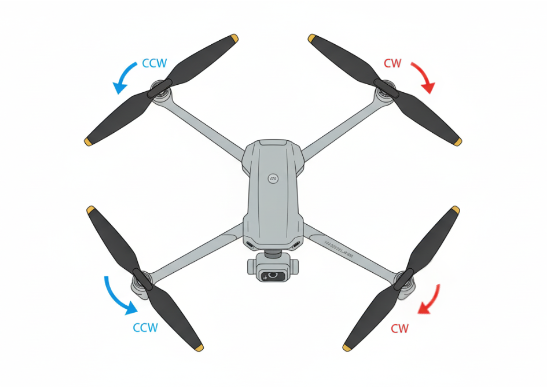
A quadcopter’s flight is a fascinating balancing act, managed thousands of times per second by its onboard computer. It uses a simple principle: to move in any direction, it just adjusts the speed of its individual motors.
The secret to its stability lies in its propeller configuration. Two of the motors spin clockwise, and the other two spin counter-clockwise. This opposing motion cancels out rotational torque, which prevents the drone’s body from spinning uncontrollably and allows for stable, precise flight.
The Core Components of Flight
Every quadcopter drone is made up of a few critical parts working in perfect harmony.
1. Frame
The frame is the drone’s skeleton. It’s the physical platform that holds all the other components together. Frames are designed to be both lightweight (for longer flight times) and incredibly durable to survive accidental bumps and hard landings. They typically come in an “X” or “+” shape.
2. Motors and Propellers
If the frame is the skeleton, the motors and propellers are the muscle. They are responsible for generating the thrust that lifts the drone. By spinning at high speeds, the propellers push air downward, creating an opposite force that lifts the drone into the air.
3. Electronic Speed Controllers (ESCs)
The ESCs are the nervous system connecting the brain to the muscle. The flight controller (the brain) sends a signal, and the ESC translates that signal into the precise amount of power the motor needs to spin at a specific speed. There is one ESC for each motor.
4. The Flight Controller
This is the central “brain” of the quadcopter. The flight controller is a small but powerful computer containing sensors like a gyroscope and accelerometer. It takes input from the pilot’s remote control, analyzes it against the data from its sensors, and makes real-time adjustments to the speed of each motor to keep the drone stable, level, or moving in the desired direction.
💰Save More with Our Discounts & Coupons!
The Different Types of Quadcopter Drones
Quadcopter drones are not one-size-fits-all. They are highly specialized tools built for specific tasks. Here are the most common types you’ll find.
Camera Drones (For Creators and Photographers)

This is the largest and most popular category. Equipped with high-resolution cameras (often 4K or even 8K) and stabilized by gimbals, these drones are designed for breathtaking aerial photography and videography. Brands like DJI have set the industry standard in this space.
Racing Drones (For Speed and Agility)
Built for pure speed and maneuverability, racing drones are small, lightweight, and incredibly powerful. Pilots fly them using FPV (First Person View) goggles for an immersive, in-the-cockpit experience as they navigate complex obstacle courses at high speeds.
Commercial & Delivery Drones (The Workhorses)
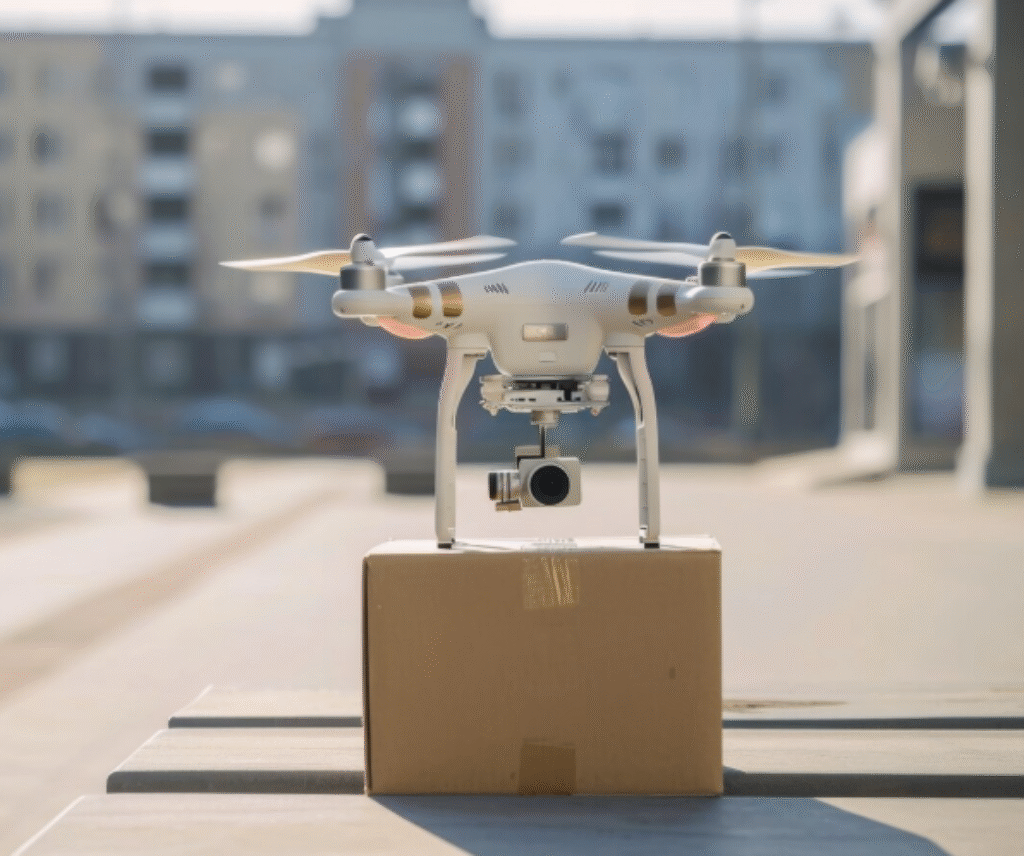
These rugged quadcopter drones are built for work. They are used in industries like agriculture, construction, and logistics. They can be outfitted with specialized payloads like thermal cameras for inspections, multispectral sensors for crop analysis, or cargo containers for package delivery.
Hobbyist & DIY Drones (For Tinkerers and Learners)
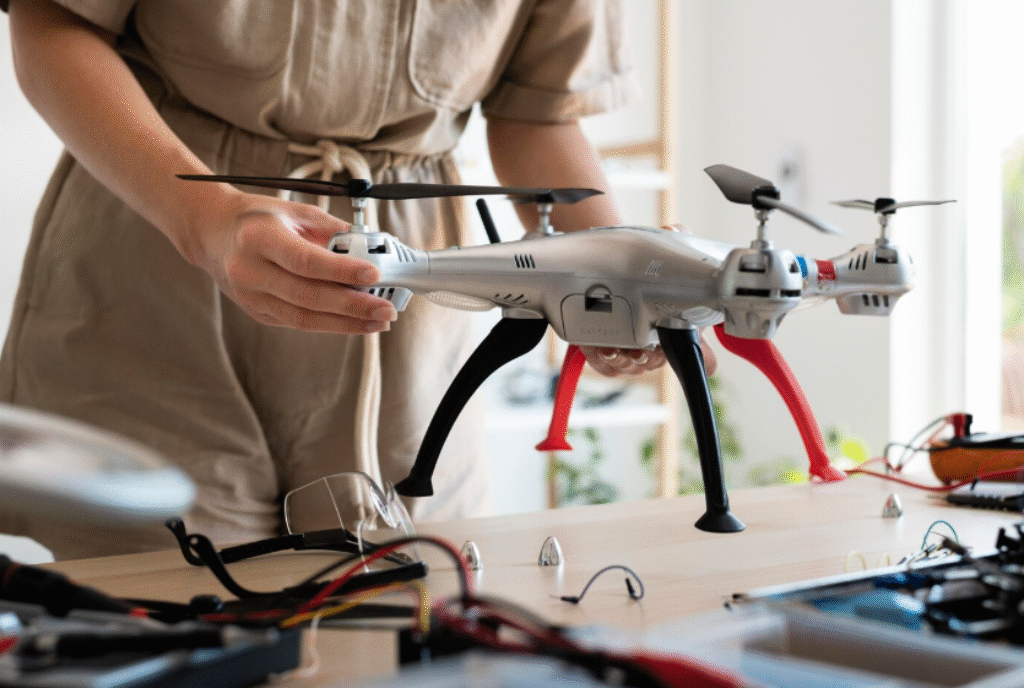
For enthusiasts who want a deeper understanding of the technology, building a DIY drone is the ultimate project. This allows for complete customization, from the frame size to the power of the flight controller, offering a hands-on education in electronics and aerodynamics.
Real-World Uses: What Are Quadcopter Drones Used For?
The applications for quadcopter drones are expanding every day across countless industries. Their ability to provide an aerial perspective safely and efficiently has made them invaluable.
- Aerial Photography and Videography: Used in filmmaking, real estate marketing, and content creation for social media.
- Search and Rescue: Deployed to locate missing persons in rugged terrain or survey disaster areas from above.
- Agriculture and Farming: Used for crop monitoring, assessing plant health, and precision spraying of fertilizers.
- Infrastructure Inspections: Safely inspecting hard-to-reach areas like bridges, wind turbines, rooftops, and power lines.
- Surveillance and Security: Monitoring large properties, public events, and assisting law enforcement.
- Delivery Services: Revolutionizing logistics by delivering small packages, medical supplies, and even food.
💰Save More with Our Discounts & Coupons!
A Note on Drone Rules and Regulations
As quadcopter drones have become more common, so have the rules governing their use. In the United States, the Federal Aviation Administration (FAA) is the primary regulatory body.
Key regulations to be aware of include:
- Remote ID: Most modern drones are now required to have Remote ID, which acts like a “digital license plate” to broadcast the drone’s location and identification information to authorities. This is a crucial rule for ensuring airspace safety.
- The Recreational UAS Safety Test (TRUST): All recreational flyers in the U.S. are required to pass this short, free online test and carry their certificate with them when flying.
Pro Tip: Regulations can vary significantly by country, state, and even city. Always check your local laws before you fly to understand where, when, and how you are legally allowed to operate your drone. An app like B4UFLY from the FAA is an excellent resource for this.
Frequently Asked Questions (FAQ)
While “quadcopter” is the most common, drones are generally classified into four main types: multi-rotor drones (like quadcopters and hexacopters), fixed-wing drones (which look and fly like airplanes), single-rotor drones (which look like miniature helicopters), and hybrid VTOL drones (which combine fixed-wing and rotor designs).
The discussion around banning DJI in the U.S. stems from national security concerns, primarily related to data security and the company’s ties to the Chinese government. While a full consumer ban is not in place, some U.S. government agencies are restricted from using DJI drones, and the issue remains a subject of ongoing political and regulatory debate.
The range varies dramatically by model. A small toy drone might have a range of only 100 feet. A typical consumer camera drone can often fly between 3 to 7 miles (5 to 12 km) away from the controller under ideal conditions. Professional long-range drones can fly even further.
Conclusion: More Than Just a Flying Camera
From their simple four-rotor design comes a world of complexity and capability. Quadcopter drones are more than just toys; they are sophisticated tools that have reshaped industries and unlocked creative possibilities we never thought possible. Driven by advancements in AI and automation, their applications will only continue to grow.
Whether you’re a photographer looking for a new perspective or a professional needing a better way to survey a worksite, understanding the core components and types of drones is the first step toward harnessing the power of aerial technology.
Ready to take flight? Explore Dealibrium’s latest deals on the top quadcopter drones for beginners and professionals alike!