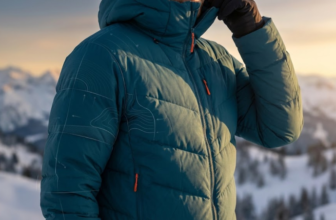
People blame their down or synthetic insulation when they feel cold in wind, but the fill is rarely the real culprit. Lab work on cold-protective clothing shows that increasing wind speed can erase up to 80–85% of your effective insulation, no matter what’s inside the jacket. This article explains how wind destroys clo, why shells and air gaps matter more than fill choice, and how to buy jackets that stay warm when it’s blowing sideways.
How wind destroys insulation (even “high-fill” down)
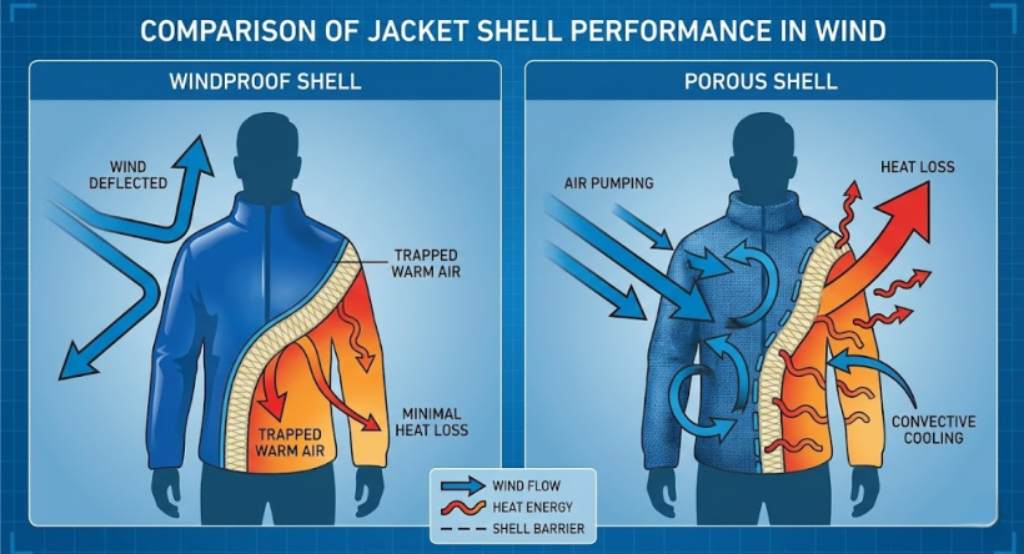
Insulation works by trapping still air. Wind increases convective heat loss, flushing that warm air away from your body and through any gaps in the clothing system.
A study on technical cold-protective textile assemblies found that increasing wind speed from 0 to 16 km/h caused assemblies to lose about 85% of their thermal insulation, even though the materials themselves did not change. Once wind penetrates or pumps air through the fabric and openings, your effective clo plummets.
- Fabric pumping: Wind presses and releases the garment against your body, pumping warm air out and cold air in.
- Micro-leaks: Neck, cuffs, hem, and zip areas act as vents when not sealed.
- Surface convection: Faster air flow over the surface increases heat loss even if the fabric is wind resistant.
Pro Tip: If you feel your jacket “isn’t warm enough” whenever it’s windy, the problem is usually wind management, not the insulation label (down vs synthetic, 600 vs 800 fill).
💰Save More with Our Discounts & Coupons!
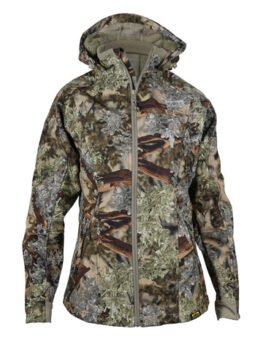
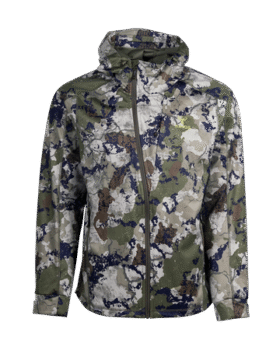
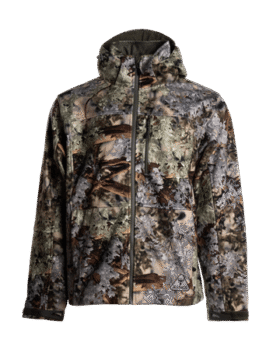
Shell fabric and air permeability: the real wind shield
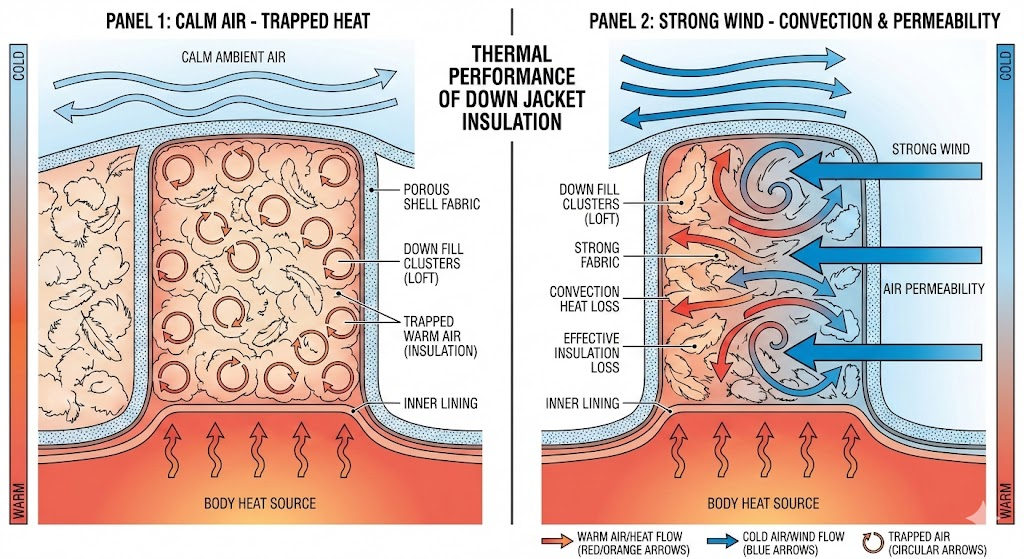
How much wind your jacket lets through is primarily controlled by the shell fabric’s air permeability, not the insulation type.
- A study on protective textile assemblies in extreme cold showed that systems with low air permeability shells maintained significantly higher insulation under wind than those with more open weaves.
- Another jacket study using a thermal manikin found that when forced convection (wind or movement) is present, dry heat loss is strongly coupled to ventilation and air permeability; more permeable fabrics lose heat faster.
- Simulations of wind-resistant layers and permeable vents confirmed that adding deliberate vents can massively increase ventilation and reduce thermal insulation, which is good in heat but disastrous if uncontrolled in cold wind.
Practical takeaway: a good windproof shell can preserve most of your insulation in gusts, while a porous or “super breathable” fabric can sabotage even the best down or synthetic fill.
💰Save More with Our Discounts & Coupons!


Movement + wind: why walking can make you colder (or warmer)
You don’t stand still in real life. Walking or climbing changes how wind interacts with your clothing system.
- Bio-heat modeling and manikin tests show that air velocity from wind combined with walking speed accelerates dry heat loss and moisture transport, especially through permeable fabrics.
- At moderate speeds, movement can improve comfort by venting excess moisture; at high wind or low temps, the same effect strips too much heat.
- Dynamic corrections in standards like ISO 9920 and heat-strain models show that effective insulation is always lower when walking in wind than static lab values suggest.
This means a jacket that feels fine in a sheltered spot can feel shockingly cold once you step onto an exposed ridge.
Pro Tip: Don’t judge a jacket just by standing still in the store or at the trailhead. Ask: “What happens when I’m walking into 20 km/h wind?” The lab data says your effective insulation can drop dramatically.
Dealibrium Take: Insulation vs wind – what actually matters
Here is how insulation type, shell, and wind interact according to the research.
Wind performance matrix: where warmth is really won or lost
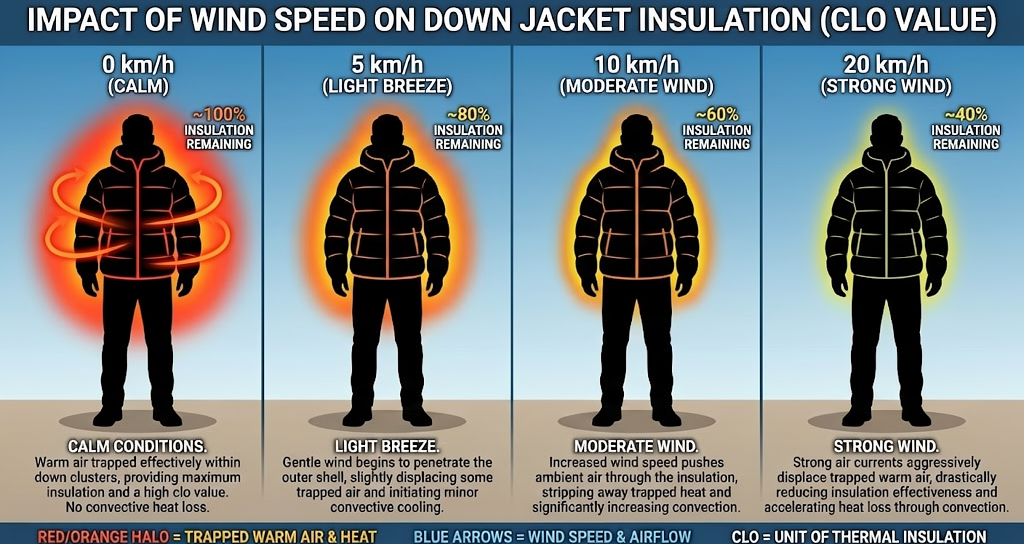
Dealibrium Take:
- Windproof shell quality often matters more than whether you chose down or synthetic.
- Porous, “super breathable” shells should be reserved for conditions where wind is mild or warmth is easy to regain.
- For real cold + wind, prioritize a low-permeability outer fabric and controlled vents over chasing higher fill power alone.
💰Save More with Our Discounts & Coupons!
How to buy jackets that actually stay warm in wind
Use these research-backed checks when evaluating jackets for windy environments:
- Check “windproof” claims and fabric type
- Inspect closures and openings
- Prefer controlled vents over uncontrolled leakage
- Match insulation level to wind exposure
- Layer a shell over your existing insulation
Pro Tip: Think of windproof shells as “clo multipliers.” The same insulation under a good shell can perform like a completely different jacket once the wind picks up.
Frequently Asked Questions
Because wind turns still air into moving air. Tests on cold-protective assemblies show up to an 85% insulation loss going from 0 to 16 km/h wind, independent of fill type. Your jacket didn’t suddenly become “bad”—your environment changed.
Often yes. Adding a dedicated windproof shell over your existing insulation can dramatically reduce convective loss. Look for a light, low-permeability shell rather than more insulation.
Not by itself. Wind attacks air gaps and shell permeability, not fiber chemistry. Synthetic can be paired with tougher, less compressible shells in workwear, which helps, but in similar shells both down and synthetic lose insulation similarly in strong wind.
Very important. Loose, flappy garments pump more air in and out. A moderately close fit with room for layers and controlled vents is best—baggy jackets leak, ultra-tight ones crush loft.
In cold, dry but windy conditions, yes. Windproofness and air permeability are more critical to staying warm than high hydrostatic head numbers. In cold, wet and windy conditions, you need both.
Key Takeaways: Don’t Blame the Fill—Blame the Wind
Wind speed can undo most of your insulation, reducing even a premium down or synthetic jacket to a thin shell of disappointment. The lab data is clear: shell design, air permeability, vent control, and fit decide whether your clo survives real-world wind.
For buying decisions:
- If your environment is windy, treat a windproof shell as non-negotiable.
- If your insulation feels fine in calm air but fails in wind, upgrade the shell, not necessarily the fill.
- If you spend time on exposed ridges, open stands, boats, or rooftops, go one insulation tier higher and insist on a properly sealed, low-permeability outer.
The smartest strategy is to stop treating “warmth” as a static property of the jacket and start seeing it as a moving target that wind is constantly trying to steal. Choose gear that fights back.